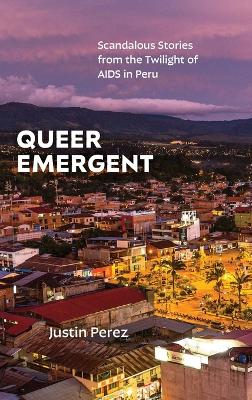
"Queer Emergent is an ethnography of sexual and medical cultures in urban Amazonian Peru at the time of a global health shift in responding to HIV/AIDS. Justin Perez, who lived alongside Peruvian gay and transgender communities between 2012 and 2018, traces the emergence of social worlds through relating the scandalous everyday stories of gay and transgender people. Taking the genre of scandal as a theory of queer world-making, Perez looks to how the community made meaning of and responded to the changing dynamics in HIV prevention, showing how the "End of AIDS" was not just a technical project oriented towards ending AIDS but a project of sexual subjectification and social transformation. Through an intersubjective and intersectional approach to ethnography, Perez illuminates the various ways that the Peruvian queer and transgender commun650ity made emergent categories of sexual selfhood habitable on their own terms"--
Justin Perez explores how advances in HIV prevention work alongside broader economic and political shifts in global health to shape queer subjectivities in urban Amazonian Peru.
In Queer Emergent, Justin Perez explores how advances in HIV prevention work alongside broader economic and political shifts in global health to shape queer subjectivities. Drawing on ethnographic research among gay and transgender communities in urban Amazonian Peru, Perez describes how queer social worlds emerge through scandalous storytelling—a practice of exaggerating and embellishing stories about everyday life that transgresses social norms and hierarchies. Perez shows that through such storytelling, gay and transgender communities contested the assumptions of global HIV prevention’s shift from the provision of costly antiretrovirals to the mitigation of social conditions like discrimination and stigma. He argues that the global ambition to “End AIDS” by 2030 is not just a technical project oriented at ending the epidemic, but also a project of sexual subjectification and ongoing social transformation. By taking seriously the scandalous stories that gay and transgender Peruvians circulated as they responded to new forms of HIV prevention, Perez reveals how they imagine possibilities of what could be as the effort to end AIDS continues to play out in the present.
In Queer Emergent, Justin Perez explores how advances in HIV prevention work alongside broader economic and political shifts in global health to shape queer subjectivities. Drawing on ethnographic research among gay and transgender communities in urban Amazonian Peru, Perez describes how queer social worlds emerge through scandalous storytelling—a practice of exaggerating and embellishing stories about everyday life that transgresses social norms and hierarchies. Perez shows that through such storytelling, gay and transgender communities contested the assumptions of global HIV prevention’s shift from the provision of costly antiretrovirals to the mitigation of social conditions like discrimination and stigma. He argues that the global ambition to “End AIDS” by 2030 is not just a technical project oriented at ending the epidemic, but also a project of sexual subjectification and ongoing social transformation. By taking seriously the scandalous stories that gay and transgender Peruvians circulated as they responded to new forms of HIV prevention, Perez reveals how they imagine possibilities of what could be as the effort to end AIDS continues to play out in the present.