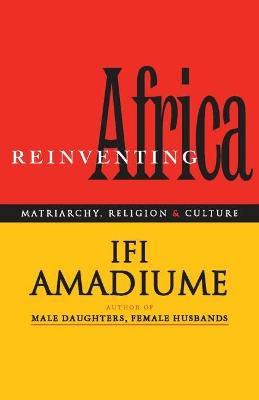
Nine essays written between 1989 and 1992 by the author of Male Daughters, Female Husbands (1987) call for a new understanding of Africa and challenge western anthropologists to recognize their own complicity in producing a vision of Africa that is often little more than a reflection of their own class-based, patriarchal thought. They emphasize how the matriarchal heritage continues to empower African women throughout the continent. Paper edition (unseen) $19.95. Distributed in the US by St. Martin's Press. Annotation c. by Book News, Inc., Portland, Or.
This extraordinary book issues a clarion call for a new understanding of Africa. The author of the best-selling Male Daughters/Female Husbands here issues a challenge to western anthropologists to recognize their own complicity in producing a version of Africa that is often little more than a reflection of their own class-based, patriarchal thought.
Professor Amadiume calls instead for a new history of Africa, made and written by Africans. This is such a book.
The book
* explores how imperialism, violence, patriarchy and class-based social structures - originally imposed by colonialism - have become internalized to result in a contemporary Africa cursed with neo-colonial states.
* uncovers the hidden matriarchal history of Africa which continues to empower women in political struggle throughout the continent
* looks at the masculinization of indigenous African religions, effected largely by the imposition of Christianity and Islam
* provides a guide to the main Afro-centric social theorists, writing a new social history of their continent.
Dedicated to the diasporic African communities in their struggle to construct alternative, anti-racist and anti-imperialist epistemologies of self-representation and self-generated ideals, this is the beginning of a new vision of Africa, from the powerful voice of an African woman.
Arvustused
'A new understanding of Africa is the clear call expounded in this excellent book... [ The author's] work skilfully points out to what she believes to be the most urgent project in African scholarship: deconstruction, demystification and decolonization of received colonial African history.' New People
'Serve[ s] to expose and and promote awareness of disciplinary rootedness in ethno- and andro-centrio bias and offer[ s] positive directions for a revision of scholarship... provocative and occasionally damning.' Journal of African History
Muu info
Challenging western anthropologists to recognize their own class-based, patriarchal thought, Ifi Amadiume, the author of
| Acknowledgements |
|
vi | (1) |
| Preface |
|
vii | |
| Introduction Writing Africa: African social history and the sociology of history |
|
1 | (26) |
| Part One Re-writing History |
|
27 | (132) |
|
1 The matriarchal roots of Africa |
|
|
29 | (23) |
|
2 Race and gender: Cheikh Anta Diop's moral philosophy |
|
|
52 | (19) |
|
3 Theorizing matriarchy in Africa: kinship ideologies and systems in Africa and Europe |
|
|
71 | (18) |
|
4 Women's achievements in African political systems: transforming culture for 500 years |
|
|
89 | (20) |
|
5 Gender and social movements in Africa: a West African experience |
|
|
109 | (35) |
|
6 Gender and the contestation of religion: a historical perspective on African societies |
|
|
144 | (15) |
| Part Two Decolonizing History |
|
159 | (49) |
|
7 African women and politics: a history of transformation |
|
|
161 | (22) |
|
8 Cycles of Western imperialism: feminism, race, gender, class and power |
|
|
183 | (16) |
|
9 In the company of women: love, struggle, class and our feminisms |
|
|
199 | (9) |
| Index |
|
208 | |
Ifi Amadiume is a award-winning poet and a political activist as well as an academic. She has lived in Nigeria and the UK and is currently associate professor at Dartmouth College, Hanover. There, she teaches in both the Department of Religion and the African-American Studies Programme. Professor Amadiume is author of the influential Male Daughters, Female Husbands (Zed Books, 1988) which won the Choice Outstanding Academic Book of the Year award in 1989.