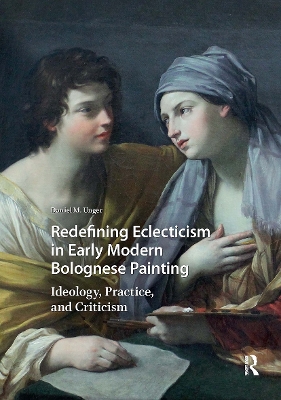
This book regards the ideology, practice, and critcism in relation to the usage of unassimilated eclecticism -the use of more than a single style- in a given work of art in Early Modern Bolognese painting.
Redefining Eclecticism in Early Modern Bolognese Painting. Ideology, Practice, and Criticism focuses on the unique nature of early modern Bolognese painting that found its expression in stylistic diversity. The flourishing of different stylistic approaches in the Mannerist paintings of the previous generation evolved, at the turn the seventeenth century, in the work of the Bolognese painters into an approach best described as eclecticism, characterized by the combination of two or more styles in a single work of art. Eclectism was a major innovation and major contribution to the history of art. But it then also became a critical term that suffered much negative press. The book therefore also traces the role of ecclecticism as a concept in the evolution of criticism and scholarship about the Bolognese school of painting over 250 years, showing how the dramatically vacillating attitudes towards this concept shaped the historical view of the Bolognese painters, ultimately having a tremendous dampening impact on our understanding of seventeenth-century art.
List of Plates and Figures Preface Introduction
Chapter One: Defining
Eclecticism - Assimilated Eclecticism - Vasari's Raphael - Arbitrary
Eclecticism - Non-Assimilated Eclecticism - A Definition
Chapter Two:
Ideology - Gabriele Paleotti's Discourse on Sacred Images - A Pictorial
Manifest: Alliance between Disegno and Colore - Carlo Cesare Malvasia and the
Assemblage of Styles
Chapter Three: Practice - The Terrestrial and Celestial
Realms - Portraits of Saints: St. Carlo Borromeo - Other Eclectic Paintings
Chapter Four: Criticism - Winckelmann's Introduction of Eclecticism into
Artistic Discourse - The Nineteenth-Century Juste milieu - The Dismissal of
Eclecticism in the Twentieth Century, Conclusion: The Eclectic Approach
Epilogue: Eclecticism in a Roman Chapel, Works Cited
Daniel M. Unger teaches the History of Early Modern Art at Ben-Gurion University, Israel. His research focuses on seventeenth-century Bolognese and Roman painting. His recent book Redefining Eclecticism in Early Modern Bolognese Painting: Ideology, Practice, and Criticism was published by Amsterdam University Press in 2019.