Muutke küpsiste eelistusi

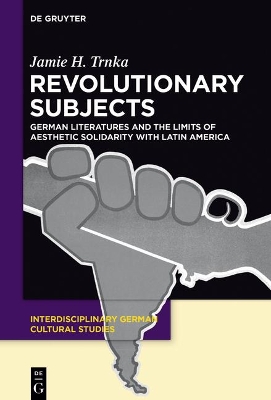
Revolutionary Subjects: German Literatures and the Limits of Aesthetic Solidarity with Latin America [Kõva köide]

Teised raamatud teemal:
"Revolutionary Subjects demonstrates that East and West German literary interests in Latin America coincided with debates about the political relevance of literature in the Cold War. Through a combination of close reading, contextual analysis, and careful theoretical work, Trnka examines textual instances of aesthetic solidarity, which, she argues, anticipated conceptual reorganizations of the world connoted by the transnational or the global" --

The author presents case studies to illustrate how transnational referents mediate first and second world political and cultural conflicts represented in German plays and novels about Latin America. Armed with the concept of aesthetic solidarity as a lens to view how political and literary actors embark on new paths across struggles and places, Trnka demonstrates how East and West German authors mobilized Latin American figures of revolutionary violence to literary-political ends. Six chapters are: geoculture, solidarity, and textual politics in East and West German writings about Latin America; the translator’s ghosts; alternative internationalisms and literary historical inversions; the task of decolonial thinking; a rhetoric of walking around; the limits of aesthetic solidarity. Annotation ©2015 Ringgold, Inc., Portland, OR (protoview.com)

Revolutionary Subjects demonstrates that East and West German literary interests in Latin America coincided with debates about the political relevance of literature in the Cold War. Through a combination of close reading, contextual analysis, and careful theoretical work, Trnka examines textual instances of aesthetic solidarity, which, she argues, anticipated conceptual reorganizations of the world connoted by the transnational or the global.

Acknowledgements xi
Chapter 1 Geoculture, Solidarity, and Textual Politics in East and West German Writings about Latin America
1(62)
Comparative and interdisciplinary contexts
7(5)
Literature and politics in divided Germany
12(7)
Material and rhetorical contexts for imagining Latin America
19(11)
Theoretical contexts: the emergence of Cold War transnationalisms, post-colonial studies, and area studies
30(10)
Imagining the Third World in German cultural studies
40(10)
Verdichtung and the emergence of aesthetic solidarity
50(13)
Chapter 2 The Translator's Ghosts: Hans Magnus Enzensberger and Latin American Compromiso in Kursbuch and The Habana Inquiry
63(58)
Charting a new course for literature
74(7)
Common places
81(9)
The Habana Inquiry
90(3)
Translating genre: testimonio in conversation with a resurgent documentarism
93(7)
Counterrevolutionary zones of equivalence
100(9)
Refusing to translate
101(2)
Translating cultural concepts
103(2)
Translating discursive systems
105(4)
Translation and comparison
109(7)
Conclusions
116(5)
Chapter 3 Alternative Internationalisms and Literary Historical Inversions: Volker Braun's Guevara or the Sun State
121(48)
State solidarity and humanist patrimony
133(3)
Expressionist redux: the New Man and the production of socialism in Volker Braun
136(8)
Productive contradictions with Latin American Marxisms
144(2)
Transcontextual interruptions
146(7)
Unforgettable guerrillera
153(6)
Authoring the New Man
159(4)
Conclusions
163(6)
Chapter 4 The Task of Decolonial Thinking: Second World Authorship in Heiner Muller's The Task
169(46)
The theaterbody and its subjects
173(12)
Latin America and the Caribbean at the intersection of revolutionary histories
185(13)
Commentary and relational reading
198(8)
The Second World intellectual and writing from the middle
206(9)
Chapter 5 A Rhetoric of Walking Around: F.C. Delius's Adenauerplatz
215(54)
A new political realism?
223(7)
From trope to rhetoric, from internationalist to transnational antifascist solidarities
230(11)
"Hinter dem Faschismus steckt das Kapital..."
241(4)
Transnational walking around and the globalization of fascist memories
245(14)
Solidary sentiments
259(7)
Conclusions
266(3)
Chapter 6 The Limits of Aesthetic Solidarity
269(24)
Aesthetics, solidarity, and the political
278(9)
Limits
287(6)
Appendix "Walking Around" 293(4)
Pablo Neruda
Donald D. Walsh
Archival Collections 297(1)
Works Cited 298(15)
Index 313
Jamie H. Trnka, The University of Scranton, Scranton, USA.