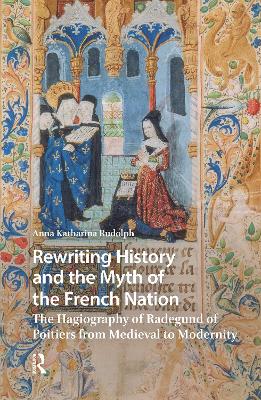
1) Gender and Hagiography This is the first book-length study of a single saint’s cult that centers gender and the role of women. In this innovative study, I use Radegund's afterlife as a case study for exploring the fluctuating dynamics of the cult of the saints and to better understand how these forces operated in relation to women's history. I trace the themes of changing expectations and behavior for women both inside and outside the convent, conventions of elite and royal women's spirituality, as well as attitudes towards marriage and sexuality. My research illuminates how the cult of the saints operates as a social construction subject both to prevailing and contested gender ideals, as well as limitations imposed by hagiographical topoi and perceived “tradition.” This book therefore makes a unique and valuable contribution to scholarship on Radegund, the cult of the saints, and the history of women’s spirituality. 2) An Expanded Chronological and Geographical Scope While most scholarship on Radegund is typically limited to an analysis of her two sixth-century biographies, my project is the first to feature post-medieval sources and cultic practices. Recent advancements in the study of the global Middle Ages have established the feasibility and benefits of widening traditional chronological and geographic scopes. However, despite the wealth of sources and their accessibility, no scholarship has engaged in an in-depth study of Radegund’s cult (or of any saint’s cult) of this scope. This book presents the most global outlook possible by tracing the cult of Radegund across borders and through multiple languages to provide a truly global look at the spread of this cultural, political, religious, and social phenomenon. I follow the proliferation of Radegund’s cult beyond the walls of Poitiers, throughout France, into England, Sicily, and even into France’s colonial possessions of Algeria and the Northern Congo. No previous study of Radegund or a single saint’s cult has been able to provide such an in-depth analytical comparison. 3) The Politics of Hagiography Even though a robust scholarship exists concerning the significant role Merovingian history has played in the development of French (and German) national consciousness from the medieval to the modern period, far less scholarly attention is devoted to how the cult of the saints fits into French nationalistic historiography. The case of Radegund has demonstrated the considerable politico-religious value of hagiography and the cult of the saints in defining “French” national identity, especially during periods of instability. This is also the first book of its kind that analyzes the afterlife of a medieval saint in conjunction with some of the most popular themes of modern political history, such as colonialism, nationalism, and public health. This multidisciplinary analysis of the cult of Radegund of Poitiers, from the sixth century to the twenty-first, illuminates the roles saints play at the intersection of gender and politics. No other medieval saint was so politically charged or had such an astonishing range of constructed personae. The many “Radegunds” encountered in this study – virgin, wife, mother, royalist, republican, colonizer – can all be interpreted as responses to contemporary political events, shifting spiritual trends, and changing attitudes towards women’s role in society or the Church. The long trajectory of Radegund’s meanings and functions over the centuries suggests that saints have played a more significant ideological role in state formation, nationalism, and identity politics than is typically recognized. To “rewrite” Radegund is thus to rewrite the history of the French nation, and this ground-breaking study shows how powerful medieval hagiography has been and continues to be in the emergence of nationalism and the “Myth of the French Nation.”