Muutke küpsiste eelistusi

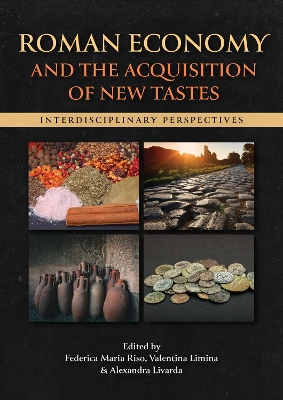
Roman Economy and the Acquisition of New Tastes: Interdisciplinary Perspectives [Pehme köide]

  • Formaat: Paperback / softback, 224 pages, kõrgus x laius: 240x170 mm, 50 maps, graphs, photographs
  • Ilmumisaeg: 31-May-2026
  • Kirjastus: Casemate Publishers
  • ISBN-13: 9798888571552
Teised raamatud teemal:
  • Pehme köide
  • Hind: 57,00 €
  • See raamat ei ole veel ilmunud. Raamatu kohalejõudmiseks kulub orienteeruvalt 3-4 nädalat peale raamatu väljaandmist.
  • Kogus:
  • Lisa ostukorvi
  • Tasuta tarne
  • Tellimisaeg 2-4 nädalat
  • Lisa soovinimekirja
  • Formaat: Paperback / softback, 224 pages, kõrgus x laius: 240x170 mm, 50 maps, graphs, photographs
  • Ilmumisaeg: 31-May-2026
  • Kirjastus: Casemate Publishers
  • ISBN-13: 9798888571552
Teised raamatud teemal:
New perspectives in the investigation of ancient economy and trade, developing alternative perspectives on lifestyle and tastes across the Roman world.

Explores Roman trade, networks, and the spread of new tastes and lifestyles across the Mediterranean and Europe.

Based on the session ‘Interdisciplinary Perspectives into Roman Commerce, Economy and the Acquisition of New Tastes during the Roman Period from the 4th Century BC Onwards’ in the framework of the 29th European Association of Archaeologists Annual Meeting, this volume aims to provide insights into current research dealing with trade, networks and the acquisition of new ‘tastes’ in the Roman world, mostly in the Mediterranean but also on parts of continental Europe. The goal is to explore Roman commerce, economy and the multifaceted lifeways, employing different methodological perspectives and lines of evidence, through the investigation of a series of selected case studies.

From the 4th century BC, the expansion of the Roman power around the Mediterranean and large parts of continental Europe had a significant impact on society, marked by political and economic changes. Creating a powerful infrastructure system increased contacts between different groups and cultures. The transport system was improved while new centers and social networks emerged.

Mobility and connectivity are, therefore, pivotal when investigating the Roman world. People, foodstuffs, plants, animals, and ideas, moved within a new social and political system where new tastes and social practices were spread, mixed and acquired. Technological improvements in shipping and in container technology, institutional factors, the state investment in transport infrastructure, such as roads and harbors, to some extent, reduced the costs of long-distance trade, and increased demand, encouraging mass production of certain goods. Interconnection led to the spread of tastes, fashions and lifestyles all over the Mediterranean and beyond.

This book ultimately sets to investigate the role of some of these ancient itineraries and networks, and that of trade, highlighting the development of new ‘tastes’ and lifestyles during the Roman period. The case studies included provide alternative perspectives on the theme, and new understandings of the impacts of connectivity and the ways to investigate it.
List of Contributors
Preface
Introduction
1. Cossutii: A Case of Trade Connectivity Between Rome and Greece in the Late
Republic
Silvia Geraci
2. Filling in the Gaps: Combining Data on Transport and Market Mechanisms in
Northern Gaul
Sonja Willems, Raphaël Clotuche, Marie Derreumaux and Gaëtan Jouanin
3. A Matter of Taste? Shared Trade of Salted Fish Produced in Lusitania and
Africa Proconsularis (3rd5th Century AD)
Sónia Bombico and Cristina Nervi
4. The Landscape of Gubbio Between Roman Power and Umbrian Identity
Marianna Negro
5. Landscapes of Power, Trade Networks and Identity Negotiation for
Invisible Economies (2nd Century BC5th Century AD): A Roman Lifestyle
Revolution?
Valentina Limina
6. Frugality and Efficiency in Catos Recipes: An Analysis from the Recipe
Collection of De Agri Cultura
Chiara Vitaloni
Bibliography
Federica Maria Riso is a Marie Curie (MSCA) Fellow at the Catalan Institute of Classical Archaeology (ICAC), in Spain. She specializes in funerary archaeology and in archaeobotany, specifically on Roman rituals and Roman food economy, through a multidisciplinary approach that combines archaeological and archaeobotanical evidence. Valentina Limina is an FSR-FNRS postdoctoral researcher at the Université catholique de Louvain. She obtained her PhD in History at the University of Pisa. Her research interests focus on landscape archaeology, settlement patterns and material culture, identity and elites power strategies in the Roman Mediterranean. Alexandra Livarda is a researcher at the Catalan Institute of Classical Archaeology (ICAC), in Spain. She studies humanplant interactions through time and what they reveal about agronomy, commerce, social structures, perceptions, and identities in the past. She specializes in archaeobotany, Aegean archaeology, and Roman commerce. She is also developing new methodological tools for the identification of past agricultural practices.