Muutke küpsiste eelistusi

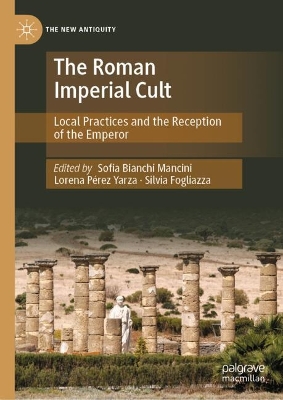
Roman Imperial Cult: Local Practices and the Reception of the Emperor [Kõva köide]

  • Formaat: Hardback, 352 pages, kõrgus x laius: 210x148 mm, X, 352 p.
  • Sari: The New Antiquity
  • Ilmumisaeg: 18-Jun-2026
  • Kirjastus: Palgrave Macmillan
  • ISBN-10: 3032140463
  • ISBN-13: 9783032140463
  • Kõva köide
  • Hind: 124,87 €*
  • * hind on lõplik, st. muud allahindlused enam ei rakendu
  • Tavahind: 166,49 €
  • Säästad 25%
  • See raamat ei ole veel ilmunud. Raamatu kohalejõudmiseks kulub orienteeruvalt 3-4 nädalat peale raamatu väljaandmist.
  • Kogus:
  • Lisa ostukorvi
  • Tasuta tarne
  • Tellimisaeg 2-4 nädalat
  • Lisa soovinimekirja
  • Formaat: Hardback, 352 pages, kõrgus x laius: 210x148 mm, X, 352 p.
  • Sari: The New Antiquity
  • Ilmumisaeg: 18-Jun-2026
  • Kirjastus: Palgrave Macmillan
  • ISBN-10: 3032140463
  • ISBN-13: 9783032140463
This book offers a novel approach to the study of the Roman imperial cult, disrupting the traditional Eurocentric narrative and tendency to relativise the cults religious dimension in favour of its political implications. Instead, this collection argues for understanding the imperial cult within diverse local contexts, where it evolved through intricate interactions with existing religious traditions and institutions. Consequently, this volume also contends that the often-promoted, singular narrative of the imperial cult fails to capture its complexity and multipolar nature, making it essential to speak of imperial cults in the plural. 


This book examines the cults flexibility and regional specificity through epigraphic numismatic, literary and archaeological evidence from Greece, Hispania (Baetica and Lusitania), Asia Minor, Italy, the Lower Danube region, Crete and Cyrene, Egypt and Germania, from the first century BCE to the fourth century CE. These sources reveal that the imperial cult was deeply embedded in local religious and social fabrics, while also engaging with distinct socio-political conditions and impacting various religious discourses, including those of Christian authors. By focusing on the local adaptations and religious innovations that characterised the imperial cult, the book advocates for a more nuanced and context-sensitive analysis.


Chapters 1, 2 and 13 are available open access under a Creative Commons Attribution 4.0 International License via link.springer.com.
1 The Polyhedron of Power: Imperial Cults Between Universality and
Locality.- 2 The Imperial Cult in Roman Attica: The Temple of Nemesis at
Rhamnous.- 3 Hadrianus Augustus Fecit: Emperors Agency and Local Traditions
in the Configuration of the Imperial Cult in Italica.- 4 Beyond
ImpositionSpontaneity: The Establishment of the Imperial Cult in Roman
Lusitania.- 5 Augustus, Tiberius, and the Concept of Str in the Asian
Peninsula: An Epigraphic Survey.- 6 Genius, Numen, Divus: Preliminary
Reflections on the So-Called Imperial Cult in the Piacenza Area.- 7 Imperial
Cults in the Greek Communities of the West Pontic Koinon.- 8 The
Representation of the Imperial Figure in the Province of Crete and Cyrene:
One Administration and Two Different Realities.- 9 A Study of the Egyptian
Kmastrion and the Imperial Cult.- 10 Epigraphic Representation of the
Imperial Figure in the Pass to the Third Century CE in Germania.- 11
Political Legitimacy Through Sacralisation in the Third Century CE.- 12 The
Deification of Antinous: From the Imperial Cult to the Christian Apologetic
Controversy.- 13 The Empires Two Bodies: Some Thoughts on the Christian
Emperor in Late Antiquity.
Sofia Bianchi Mancini is currently a Postdoctoral Researcher, Junior Fellow and Principal Investigator at the Max-Weber-Kolleg für kultur- und sozialwissenschaftliche Studien at the University of Erfurt, Germany.


Lorena Pérez Yarza is a Postdoctoral Researcher (adiunkt) at the University of Warsaw, Poland, and currently affiliated with the Spanish research groups Hiberus and Historia e Historiografía de las Religiones.


Silvia Fogliazza is an archaeologist currently affiliated with the International Study Centre of Ancient Religions (Ca Foscari University), the research group Poikilia and the Istituto Nazionale di Studi Etruschi ed Italici (Sezione Etruria padana e Italia settentrionale), Italy.