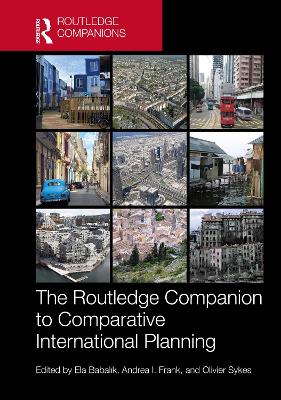
This companion provides an overview of a rich field of scholarship and practice, covering key debates around the purpose and value of comparison as a way of generating knowledge and theory. It features examples of comparative studies which explore contemporary issues in planning for sustainable urban and territorial development.
Across seven parts, the book explores questions of ‘why’ engage in international comparative planning research; ‘what’ planning aspects might be compared; and ‘how’ comparison might be approached. Through compelling cases of contemporary comparative research on diverse planning topics, including planning systems and governance, planning instruments and law, urban morphology, planning for risk, perspectives on informality, comparative pedagogy and more, readers will gain a wide appreciation of comparative studies and the current state of the field. The book is comprised of 37 chapters by 61 contributors from around the world, offering their vital insights into the vibrant and evolving scholarship.
The companion will be of interest to educators, academics and researchers, planning practitioners, city and municipal governments, consultants, and advanced students, in the fields of city, urban, and regional planning, urban design, human geography, and urban, environmental, and international development studies, interested in comparing and co-learning from global practices and places.
Across seven parts, the book explores questions of ‘why’ engage in international comparative planning research; ‘what’ planning aspects might be compared; and ‘how’ comparison might be approached.
Part I: Background to International Comparative Planning
1. Introduction
2. A History of International Comparison: Theory, Methods and Practice
3.
What Is Published as International Comparative Planning Research in Academic
Journals? Part II: Why Compare? The Aims and Objectives of International
Comparison for Planning and Urban Policy
4. Modes of Inter-Urban Comparisons
and Theory Building
5. Beyond (and Between) the Global City? Exploring a
Framework to Strengthen Policy Mobility Between Differing Urban Scales
6.
Knowledge Co-Production Through International Comparison: Transnational
Territorial Knowledge Communities in Action
7. Spatial Planning Outcome
Assessment in International Comparison
8. Limits on the International
Mobility of Planning Ideas and Practices: Some Historical Lessons
9.
Decoloniality of International Comparative Planning Research
10. Benchmarking
Responses to Urban Shrinkage: Balancing Normative Dimensions in the Planning
Concept of "Shrinking Smart" Part III: What to Compare?
11. Comparative Urban
Planning Law: Theories, Methodologies, and Challenges
12. Planning Systems
Compared A Reflection on the State of Art
13. Comparing Planning Policy
Instruments
14. Planning Culture
15. "Governance Approaches" to Study
Planning Systems
16. Where Is Design in Planning Education? An International
Comparison of Planning Programmes in England, Italy and Portugal Part IV:
Comparative International Planning Research
17. How to Make Peace with
Informality: Deconstructing The Black Box Of Spatial Informality In Land Use
18. The Right to the City: Worldwide Concept and a Brazilian Perspective
19.
Rural Development Planning in Europe: The Challenges and Results of a
Comparative Approach
20. Resilience and Risk Mitigation: Making the Case for
Working Across Silos and Cross-Case Learning
21. Neighbourhood Models for
Public Health: A Comparative Retrospective Over the Last Century
22.
Comparative Studies in Cultural Heritage and Urban Conservation: Integration
in the British and German Planning Systems
23. International Comparative
Transport Planning Studies
24. Transit Oriented Development: Improving Urban
Sustainability
25. Digitalisation, Urban Data and the 15-Minute City
26.
Comparing the Adoption of Digital Data and Technologies in Planning
27. Urban
Form and Urban Morphology: Professional and Academic Approaches
28.
Comparative International Studies on Public Spaces: Benefits and Limitations
Part V: Informing Global Agendas and Professional Practice Through Comparison
29. International Planning Guidelines and Diffusion to Local Planning
30.
Liveability and Its Implications in Comparative Spatial Planning
31.
International Comparison of Experiences and Knowledge Exchange in
Metropolitan and Regional Networks: A View from Stuttgart Region (Germany)
32. International Collaborative Planning Through Private Consultancy Part VI:
Education in and for Comparative International Planning
33. Teaching
International Comparative Planning in a Globalised Higher Education Context:
Pedagogical Imperative and Challenges
34. Developing Comparative
Competencies: The International Planning Studio
35. Developing Comparative
Study Competencies Through Lived Experiences: Semester Abroad
36. Global
Planning Education and Online Pedagogy: An Inquiry into Implementation Part
VII: Conclusions and Future Developments
37. International Comparative
Planning: Key Findings and Future Agendas
Ela Babalk is Professor of City and Regional Planning, and a transport policy expert. Having been a member of the academic staff for over 25 years at the Department of City and Regional Planning in the Middle East Technical University (METU), Ankara, Turkey, she is teaching urban transport planning and transport policy as a part-time instructor at METU as well as carrying out training, policymaking projects, and consultancy work at the national and international level. Her areas of expertise include transport policy, sustainable mobility, climate change mitigation and adaptation, and planning education.
Andrea I. Frank is Associate Professor in Urban and Regional Planning at the University of Birmingham, UK. Other than in the UK, she previously has held academic appointments in the USA, Germany, and Indonesia. Her areas of expertise include sustainability, public participation, creativity, planning pedagogy, and education for planning as well as international and comparative planning. With Christopher Silver, she is co-editor of Urban Planning Education: Beginnings, Global Movement and Future Prospects (2018) and Teaching Urban and Regional Planning (with A.R. Pires, 2021).
Olivier Sykes is Associate Professor in European Spatial Planning and Discipline Lead for Planning at the University of Liverpool. His research and teaching address the fields of European spatial planning, international planning studies, and comparative urban policy and regeneration. He is co-author of International Planning Studies: An Introduction (2023) and co-editor of Planning in a Failing State: Reforming Spatial Governance in England (2024).