Muutke küpsiste eelistusi

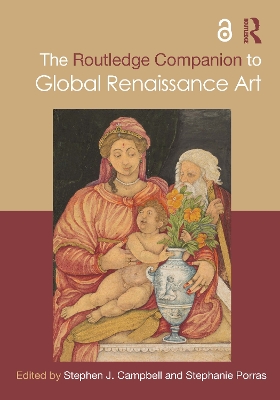
Routledge Companion to Global Renaissance Art [Kõva köide]

Edited by (The Johns Hopkins University, USA), Edited by (Tulane University, USA)
  • Formaat: Hardback, 718 pages, kõrgus x laius: 246x174 mm, kaal: 2140 g, 1 Line drawings, color; 37 Halftones, color; 136 Halftones, black and white; 38 Illustrations, color; 136 Illustrations, black and white
  • Sari: Routledge Art History and Visual Studies Companions
  • Ilmumisaeg: 22-Jan-2024
  • Kirjastus: Routledge
  • ISBN-10: 1032261587
  • ISBN-13: 9781032261584
Teised raamatud teemal:
  • Kõva köide
  • Hind: 250,31 €*
  • * hind on lõplik, st. muud allahindlused enam ei rakendu
  • Tavahind: 333,75 €
  • Säästad 25%
  • Raamatu kohalejõudmiseks kirjastusest kulub orienteeruvalt 3-4 nädalat
  • Kogus:
  • Lisa ostukorvi
  • Tasuta tarne
  • Tellimisaeg 2-4 nädalat
  • Lisa soovinimekirja
  • Formaat: Hardback, 718 pages, kõrgus x laius: 246x174 mm, kaal: 2140 g, 1 Line drawings, color; 37 Halftones, color; 136 Halftones, black and white; 38 Illustrations, color; 136 Illustrations, black and white
  • Sari: Routledge Art History and Visual Studies Companions
  • Ilmumisaeg: 22-Jan-2024
  • Kirjastus: Routledge
  • ISBN-10: 1032261587
  • ISBN-13: 9781032261584
Teised raamatud teemal:
"This companion examines the global Renaissance through object-based case studies of artistic production from Africa, Asia, the Americas and Europe in the early modern period. The international group of contributors take an art historical approach characterized by close analysis of form and meaning as well as function, and a focus on questions of cross-cultural dialogue and adaptation. Seeking to de-emphasize the traditional focus on Europe, this book is a critical guide to the literature and the state of the field. Chapters, outline new questions and agendas while pushing beyond familiar material. Main themes include workshops, the migrations of artists, objects, technologies, diplomatic gifts, imperial ideologies, ethnicity and indigeneity, sacred spaces and image cults, as well as engaging with the open questions of "the Renaissance" and "the global." This will be a useful and important resource for researchers and professors alike and will be of interest to scholars working in art history, visual culture, material culture and Renaissance studies"--

This companion examines the global Renaissance through object-based case studies of artistic production from Africa, Asia, the Americas and Europe in the early modern period.


This companion examines the global Renaissance through object-based case studies of artistic production from Africa, Asia, the Americas, and Europe in the early modern period.

The international group of contributors take an art historical approach characterized by close analysis of form and meaning as well as function, and a focus on questions of cross-cultural dialogue and adaptation. Seeking to de-emphasize the traditional focus on Europe, this book is a critical guide to the literature and the state of the field. Chapters outline new questions and agendas while pushing beyond familiar material. Main themes include workshops, the migrations of artists, objects, technologies, diplomatic gifts, imperial ideologies, ethnicity and indigeneity, sacred spaces and image cults, as well as engaging with the open questions of “the Renaissance” and “the global.”

This will be a useful and important resource for researchers and professors alike and will be of interest to scholars working in art history, visual culture, material culture, and Renaissance studies.

The Open Access version of this book, available at http://www.taylorfrancis.com, has been made available under a Creative Commons [ Attribution-Non Commercial-No Derivatives (CC-BY-NC-ND)] 4.0 license

1. Introduction: Teaching the Global Renaissance
2. Workshops:
Translations of media and techniques
2. Introduction to Part 1: The Mechanics
of Cultivating Desire: Connecting Early Modern Objects, Artisans, and
Workshops 2.1 Between Cairo and China: Design, Paper, and Ottoman Metalwork
c. 1500 2.2 Your Parcel is on the Way: Netherlandish Carved Altarpieces as
Exported Products in the Early Sixteenth Century 2.3 Early Modern Artistic
Globalization from Colonial Mexico: The Case of Enconchados 2.4 Nanban
Lacquer: Global Styles and Materials in a Japanese Cabinet 2.5 The Global
Renaissance in Colonial Mexico: The Case of Talavera Poblana Ceramics
2.6Material Histories of Whiteness and Jingdezhen Porcelain
3. Terminology:
Alternative Geographies and Temporalities
3. Introduction to Part 3: The
Renaissance, the Revenant: A Hauntology of Art History 3.1 Sovereign Time:
A Clockwork Art History 3.2 Global Ivories: cross-cultural appropriations,
dialogues, and (dis)connected art histories between Europe and South Asia 3.3
Palermos Renaissance Misfit 3.4 Materials and Medallions: Picturing Global
Objects from Early Modern Paris 3.5 A Global Experiment in Printing: The
Circulation of the Nestorian Stele from Xian 3.6 Decentering the
Renaissance: Afro-Eurasian Itineraries of Mamluk Metalwork 3.7 Otter
Offerings: Indigenous Art History and Extractive Ecologies in the Circumpolar
North 4.Transregional Emulations/Rethinking Empire
4. Introduction to Part 4:
The Mimetics and Discontents of Empire 4.1 Sigismund III of Poland, Persian
Carpets, and the Pitfalls of Provenience 4.2 The Mughal Imperial Image
between Manuscript and Print 4.3 Saved by Medusa: The Medici Moor from the
Bargello to the Met Breuer 4.4 Benin Ivory Pendant Pair: Honoring an
Ambitious Mother 4.5 The Art of the Book in early modern Kashmir: The case of
an Illuminated Manuscript of Dwn-i Hfiz 4.6 Forging cultural universes in
the Mediterranean Renaissance: Altarpieces in Sardinia, prints by Raphael and
connections with the Flemish and Spanish worlds
5. Literary and material
poetics
5. Introduction to Part 5 5.1 Renaissance as Refreshment in the
Mughal Empire: Floral Carpets and the Tarz-i Taza (Fresh Style) in
Seventeenth-Century South Asia 5.2 Iranian blue-and-white underglaze-painted
ceramic vessels and tombstones inscribed with Persian verses, c. 14501700
5.3 How to Read a Chinese Painting in a European Book 5.4 I Was Made from
Earth: A Rhineland Archeological Discovery, 1572 5.5 A Painting of a Painting
and a Boy on a Bottle: Thresholds of Image in Early Modern Iran 5.6 The
Global Air: Atmospherics in Chinese Ink Painting in the Seventeenth Century
6. Translating the sacred
6. Introduction to Part 6 6.1 Space, Time and Power
in an Ethiopian Icon, ca. 1500 6.2 The Cotinga and the Hummingbird: Material
Mobilities in the Early Colonial Featherworks of New Spain 6.3 Goa Dourada:
The Tomb of St. Francis Xavier in Portuguese India 6.4 Pilgrims and their
Objects as Agents of Cultural Hybridization: the English Alabaster Altarpiece
of Santiago de Compostela, Spain 6.5 Angels in a New Dimension: Christian
Tapestries and the Southern Andean Religious Tradition 6.6 Itinerant
Sephardic Judaica: from Dutch ports to the harbours of Europe and the
Americas 6.7 Recounting Beads of History in the Conception of the Image of
Our Lady of the Rosary of La Naval, Manila 6.8 A Last Judgment print from
Flanders: paths of Michelangelo towards Spanish America 6.9 Visualizing
Faith: The Emerald Buddha in fifteenth-century Northern Thailand
7.
Constructed Spaces and Perspectives
7. Introduction to Part 7 7.1 Towers,
Travel, and Architectural Habits 7.2 The church of Our Lady of the Rosary of
Black People in Salvador (Brazil), and the enslaved painter António Telles at
Olinda 7.3 A Mobile Shrine: The Global Cult of the Santa Casa 7.4 The Great
Mosque of Kilwa: An Architectural Lodestone 7.5 Beijing and Beyond: Imperial
Landscapes and Early Modern Cosmopolitan Rulership in Qing-era
Stephen J. Campbell is Henry and Elizabeth Wiesenfeld Professor in the Department of the History of Art at The Johns Hopkins University.

Stephanie Porras is Chair of the Newcomb Art Department and Professor of Art History at Tulane University.