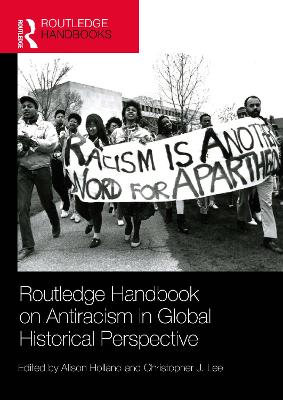
This Handbook is the first multidisciplinary anthology of research on antiracism in global historical perspective. It demonstrates the importance of a historical lens for understanding the deep lineages of antiracism and reveals the myriad ways—transracial, transnational, and transhistorical—that antiracism has shaped world history.
Drawing on case studies from Africa, Asia, Australia, Europe, South America and North America from the eighteenth century to the present, this volume situates antiracism in a variety of temporal, geographical and ideological contexts that span the globe. By highlighting the perspectives of racially marginalized individuals and communities, it showcases the distinctiveness and importance of key thinkers, ideas, and methodologies in regional and national contexts. Further, by recovering complex histories, including memories and legacies, of antiracism, this Handbook illustrates how faultlines of race, class, and gender informed internal debates, priorities and outcomes. It emphasizes the creativity and labour of antiracist activism at the local and international levels.
The Routledge Handbook of Antiracism in Global Historical Perspective ultimately underscores the diverse genealogies of antiracism and its transnational networks of political solidarity in order to contribute to future research and teaching as well as political praxis in the present. A vital resource for students, teachers and activists alike, it presents a synthesis of some of the best work on antiracism to date by leading scholars, both emerging and internationally recognized, across the humanities and social sciences.
This Handbook is the first multidisciplinary anthology of research on antiracism in global historical perspective. It demonstrates the importance of a historical lens for understanding the deep lineages of antiracism and reveals the myriad ways—transracial, transnational, and transhistorical—that antiracism has shaped world history.
Arvustused
Approaching antiracism as a global phenomenon with deep historical roots, the editors have put together a fascinating collection that illuminates the extraordinary heterogeneity of anti-racist thought, movements and legislation. Bringing radical, indigenous and diasporic perspectives into conversation, the Routledge Handbook on Antiracism in Global Historical Perspective is at once a major educational resource and an important activists handbook. Professor Laura Chrisman, Nancy K. Ketcham Endowed Chair of English, Washington UniversityFramed in terms of the dialectical struggles between racism and antiracism the Routledge Handbook on Antiracism in Global Historical Perspective offers a wide-ranging collection of studies on histories of antiracism. The volume includes strong analyses of antiracism in long and well-documented contexts as well as those much less commonly discussed. In this it offers a compelling resource for both pedagogical and research purposes. A valuable resource, especially in our current moment, for understanding antiracism, historically and contemporarily. Professor David Theo Goldberg, Distinguished Professor University of California, IrvineDrawing on a global set of case studies, across two-hundred years, the Routledge Handbook on Antiracism in Global Historical Perspective gives us a vital, long overdue, account of how race and its opponents built the modern world. Never losing sight of the historic pliability of race, Alison Holland and Christopher J. Lee demonstrate that antiracism is as diverse and evolving as the system of control, domination and hierarchisation it opposes. This is activist history at its best. Dr Jon Piccini, Senior Lecturer, Australian Catholic University
Prologue: A Song of Hope; Introduction: Why Antiracism in Historical
Perspective Part I Anti-Slavery and Anti-Lynching as Antiracism
1. Abolishing
the Inhuman Distinction of Colors
2. Against Race: Ida B. Wells and
Anti-Lynching Part II Early Twentieth Century Antiracism
3. Harold Moody: The
League of Coloured Peoples and Black British Antiracism
4. Landscapes of
Exclusion: Chinese Canadians and the Structural Challenges of Anti-Racist
Activism in British Columbia
5. Arturo Schomburg and the Building of an
Antiracist Archive
6. From Anti-Semitism to Anti-Colonialism: The Evolution
of Soviet Antiracism Part III Anticolonialism and Antiracism between the Wars
7. Anticolonialism and Black Radicalism in the 1930s
8. The Communist Party
of Australia, Trade Unions and the Struggle for Aboriginal Rights, 1920 -1939
9. International Communism, Anticolonialism and Antiracism between the First
and Second World Wars Part IV Antiracism after World War II
10. The Gigantic
Unpredictable: Reading Empire with C.L.R. James
11. The Antiracism of Frantz
Fanon
12. Paul and Eslanda Robesons Lifelong and Transnational Fight against
Racism
13. The Legacy of the Mau Mau: An Ongoing Fight Against Colonialism
and Racism in Kenya
14. Slow Steps, Compromises and Blind Spots in the
Development of Ashley Montagus Antiracism
15. Black Sisters on Whose
Shoulders We Stand: a Passion to Fight Apartheid Injustice Some Reflections
Part V Human Rights and Antiracism
16. Advocating for Justice, Confronting
Racism: Japanese Canadian Resistance, Community and the Language of Human
Rights During and After World War II
17. Anticolonialism, Antiracism and
Human Rights
18. Human Rights and Antiracism in Australia: Indigenising a
Movement, 1930-1950 Part VI Black Power as Antiracism
19. The Black
Consciousness Critique of Europe
20. The Brazilian Black Movement in
Historical Perspective
21. Black Power in Britain: An Introductory History
VII Antiracism in National Settings
22. Reconsidering US Antiracism:
1945-1970
23. Arab Americans, Palestinian Solidarity, and Antiracism,
1960s-1980s
24. Not Blacks, but Citizens: Antiracism and the 1959 Cuban
Revolution
25. Antiracism in France
26. Swedish Solidarity and the
Anti-Apartheid Struggle: The Phantoms Role in Comics and Activism
27.
Confronting Anti-Muslim Racism in the US Part VIII The Past in the Present:
Contemporary Antiracisms
28. Critical Race Theorys Essentialist Flaws: An
Insiders Reflections and Provocation
29. Antiracism in Latin America:
Alternative Grammars and Racialized Class Consciousness
30. Contemporary
Antiracism and Policing: Duty of Care and Legacies of Colonial Power in
Australia and Fiji
31. Antiracist Feminism and Queer of Colour Activism in
the Nordic Region
32. From Equality of Opportunity to Equality as a Result:
Evaluating Antiracist Ideologies in the Post-Civil Rights Era; Epilogue
Palestine is a Volcano: On the Power of Anticolonial & Antiracist Resistance;
Afterword Universities v Protest: A letter from a lesser alumnus
Alison Holland is an Associate Professor in the School of Humanities at Macquarie University, Sydney. She has published two monographs: Just Relations. The Story of Mary Bennetts Crusade for Aboriginal Rights (2015) and Breaking the Silence. Aboriginal Defenders and the Settler State, 19051939 (2019). She is the editor of Rethinking the Racial Moment. Essays on the Colonial Encounter (2012). She is currently writing a history of the Aboriginal and Torres Strait Islander Commission and is on the editorial board of Black Histories: Dialogues.
Christopher J. Lee is an independent scholar who has published twelve books, including Making a World after Empire: The Bandung Moment and Its Political Afterlives (2010, rev. 2nd edition 2019), Unreasonable Histories: Nativism, Multiracial Lives, and the Genealogical Imagination in British Africa (2014), Frantz Fanon: Toward a Revolutionary Humanism (2015), Kwame Anthony Appiah (2021), and Alex La Guma: The Exile Years, 19661985 (2024). He is currently the lead editor of the journal Safundi.