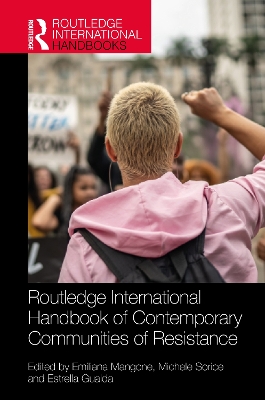
In an era defined by social upheaval and rapid digital transformation, this Handbook offers a compelling exploration of how communities are reshaping the cultural, economic, and political fabric of contemporary life. It argues that todays social and digital spaces have evolved into a new kind of public agoranot simply arenas for critique, but dynamic sites where citizens collectively reinvent the foundations of democratic life.
At the heart of the Handbook is the concept of the community of resistance: groups of individuals who, facing crisis or unsettling change, come together to protect and reinforce their social bonds, identities, and institutions. Through these collective practices, they forge new forms of participatory citizenship and grassroots activism that challenge traditional power structures.
Blending theory, case studies, and critical analysis, the Handbook reveals how these bottomup initiatives are increasingly shaping political agendas and seeking institutional recognition. It illuminates a vibrant field of democratic experimentationone in which everyday people are turning resistance into policy, transforming activism into legitimacy, and reimagining what it means to participate in public life. It will appeal to students and scholars in the social sciences, particularly to those interested in community, the digital transformation of society, social movements, and political resistance.
PART I: INTRODUCTORY REMARKS: BETWEEN EXISTING AND RESISTING;
1.
Rethinking the concept of community in its many forms within the fragmented
society;
2. Communities of resistance between empowerment and direct social
action;
3. Virtual Communities as Communities of Resistance: Past Experiences
and New Challenges on the Platform Society; PART II: RESISTANCE AND
RESILIENCE;
4. Solidarities of Difference as a Theoretical Foundation for
Communities of Resistance;
5. Religious communities as sites of resistance:
beyond identity;
6. Communities of Food Activists: Communication and
Prefigurative Politics in Solidarity Purchasing Groups (GAS);
7. Commoning
Resistance: Food Sovereignty and New Rurality in the Cilento Region in
Southern Italy;
8. From communities of resistance to resilient communities:
Practices for building a new post-disaster social order; PART III: COMMUNITY
PRACTICES: COLLECTIVE ACTION AND DIRECT SOCIAL ACTIONS;
9. Communities:
Between resisting and existing;
10. Social and racial inequalities in Brazil:
A look at anti-racist resistance struggles in contemporary times;
11.
Indigenous peoples and planetary health: From resistance to governance;
12.
Confronting the State: Forming Political Communities, Visibilising
Disapearance in Algeria;
13. (Re)claiming Taiwan: Indigenous people and
Taiwanese energy transition - between reclaiming land, constructing identity,
and building security;
14. Enabling or Hindering Resistant Knowledge?
Comparing Interactions Between State and Anti-Violence Against Women
Movements in Denmark and Italy;
15. Solidarity Economy Initiatives as
Communities of Resistance in Lebanon; PART IV: ANTAGONISM AND CULTURAL
RESISTANCE IN ANALOGICAL AND DIGITAL SPACE;
16. Digital Publics as Emotional
Communities in the Context of Therapeutic Culture: The Search for Optimal
Emotion Management for Mindful Problem Solving (Mindfulness School in
Contemporary Russia);
17. Affective publics and participatory security:
digital communities of resistance in the Donnexstrada and Scrivi quando
arrivi cases;
18. Communities in the Game World Between Online and Offline:
Virtual Terrain Between Activism, Social Influence and Resistance;
19.
Artistic practices and community of resistance: The Encounter Between
Kepler-452 and the ex-GKN Workers' Movement;
20. Poetry Between
Technocreative and Community Process; CONCLUSIONS;
21. Conclusions. Community
Between Practices and Resistance: New Challenges
Emiliana Mangone is Full Professor of Sociology of Cultural and Communication Processes at the Department of Political and Communication Sciences, University of Salerno (Italy). Her main research interests are in the field of cultural and institutional systems, with particular attention to the social representations, relational processes, knowledge and narrative as key elements to the human act, in migration studies, and as well as the study of the thought of Pitirim A. Sorokin. She recently published: (with G. Gili) Towards a Sociology of Hope: Looking Beyond (2025) and (with G. Russo), Culture and Everyday Life in Rela(c)tion (2025).
Michele Sorice is Full Professor of Media Studies at the Department of Communication and Social Research (CoRiS), Sapienza University of Rome. His main research activities are in the field of critical sociology and critical media studies (communication and civic engagement, digital platforms and media, media and democracy, democratic innovation and participatory processes, political communication, neoliberalism and depoliticisation, digital activism and social movements). He recently published: (with L. Viviani), The Public Role of Italian Sociology: Among Institutions, Universities and Social Engagement (The American Sociologist, 2024) and (with M.C. Antonucci & A. Volterrani), Confini invisibili. Comunitą liminali e pratiche di resistenza nella cittą neoliberista (2024).
Estrella Gualda is Full Professor of Sociology at the University of Huelva (Spain) at the Department of Sociology, Social Work and Public Health where is Director of the Social Studies and Social Intervention Research Centre. She has a particular interest in transdisciplinary and interdisciplinary approaches to social, political, economic and cultural issues, advances in research methods, techniques and software for social and applied sciences, sociological and other social science theories. She recently published: (Ed.), Teorķas de la conspiración discursos de odio en lķnea en la sociedad de las plataformas. Comparación de pautas en las narrativas y redes sociales sobre COVID-19, inmigrantes, refugiados, estudios de género y personas LGTBIQ+ (2024) and (with A. Pocecco & E. Mangone, Eds), Collective Memory Narratives in Contemporary Culture (2023).