Muutke küpsiste eelistusi

Russian Strategy in the Middle East and North Africa [Pehme köide]

  • Formaat: Paperback / softback, 288 pages, kõrgus x laius x paksus: 234x156x16 mm, kaal: 414 g
  • Sari: Russian Strategy and Power
  • Ilmumisaeg: 20-Jan-2026
  • Kirjastus: Manchester University Press
  • ISBN-10: 1526195585
  • ISBN-13: 9781526195586
Teised raamatud teemal:
  • Pehme köide
  • Hind: 29,40 €*
  • * hind on lõplik, st. muud allahindlused enam ei rakendu
  • Tavahind: 36,75 €
  • Säästad 20%
  • Raamatu kohalejõudmiseks kirjastusest kulub orienteeruvalt 3-4 nädalat
  • Kogus:
  • Lisa ostukorvi
  • Tasuta tarne
  • Tellimisaeg 2-4 nädalat
  • Lisa soovinimekirja
  • Formaat: Paperback / softback, 288 pages, kõrgus x laius x paksus: 234x156x16 mm, kaal: 414 g
  • Sari: Russian Strategy and Power
  • Ilmumisaeg: 20-Jan-2026
  • Kirjastus: Manchester University Press
  • ISBN-10: 1526195585
  • ISBN-13: 9781526195586
Teised raamatud teemal:
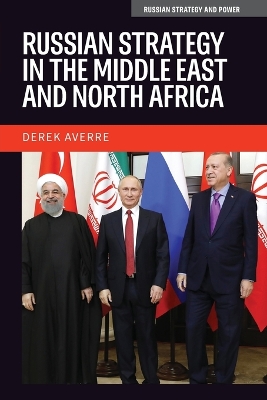
The book analyses Russia’s political and economic interests in the Middle East and North Africa, its relations with the MENA countries and its diplomatic engagement with the Western powers. It examines Russia’s strategy in the region, including its role in the Syria conflict, in the context of its broader foreign policy and war with Ukraine.

This book analyses Russia’s strategy in the Middle East and North Africa (MENA) in the turbulent period since the inception of the Arab Spring. It explores the key policy challenges faced by Russia in the context of Russia’s relations with both the regional states and the major external powers. The book incorporates chapters on Russia’s involvement in MENA affairs, its intervention in the Syrian civil war, the domestic sources of its foreign policy, its clash with the Western powers over issues pertaining to sovereignty and humanitarian norms, its response to the challenge posed by Islamist extremism, and its political-military and economic interests in the MENA region. The book offers an original, critical analysis of Russia’s thinking and decision-making and examines the implications of its more assertive foreign policy strategy following its military interventions in Syria and Ukraine.

Arvustused

Averre's monograph is one of the few books I consider to be essential for understanding the complexity of Russia's relationship with the Middle East. Mark N. Katz, Professor Emeritus, George Mason University

Averres important work shows how Russias complex, multi-faceted strategy in the Middle East and North Africa is often misunderstood by Western commentators. The book is essential reading for getting Russia right.' James Nixey, Former Director, Russia and Eurasia Programme, Chatham House

'The importance of understanding Russias transformational involvement in the MENA region, which is marked by proxy conflicts, shifting alliances and normative struggles over sovereignty, cannot be overestimated. Derek Averres new book offers a persuasive account of the security interests as well as the regional and domestic dynamics that shaped Russias MENA policy, from its response to the Arab Spring to its relations with a network of regional, external and non-state actors... As a result, the book offers a comprehensive account of Russian decision-making and a far more layered account than those centred on material capabilities, international norms or authoritarian opportunism alone.' Kalina Zhekova, International Affairs

'The author demonstrates the fragility of often dominant perspectives, such as the view that Russian strategy is solely driven by a desire to restore its international status to Soviet-era levels. Averre shows how such simplistic interpretations fail to capture the broader spectrum of internal and external, structural and contingent, factors that influence and define the Russian approach.' Nicolò Murgia, The International Spectator

CHOICE Recommended: Graduate students and faculty. 'Russian Strategy in the Middle East and North Africa is a valuable contribution to the literature on Russias foreign policy... Averre (Univ. of Birmingham, England) forgoes analyzing Russian actions through a single foreign policy lens, instead using an eclectic, analytical approach to explain Russian foreign policy in the region since 2011. The study employs four explanatory factors: structural power, the Russian elite's conceptions of international norms, domestic politics, and Vladimir Putins agency. The result is a rich and detailed account of the motivations of Russian action... With recent developments in Syria, the book is crucial for understanding how unfolding events may affect Russias interests in the region.' --J. R. Clardie, Northwest Nazarene University -- .

Introduction: the Arab Spring and Russia
1 Russia and the MENA region: state fragmentation, inter-state rivalries and
international discord
2 Russia and the Syrian civil war
3 Russias domestic politics and the Arab Spring
4 Russia, the Arab uprisings and international norms
5 Religion and terrorism: the challenge of the Arab Spring
6 A Russian strategy for the MENA region?
Conclusions
Index -- .
Derek Averre is Honorary Reader at the University of Birmingham -- .