In the last decade, at least two European Union (EU) member states have deteriorated from fragile liberal democracies to illiberal regimes. This deterioration not only includes key elements of the rule of law, but also mechanisms of democratic accountability have eroded. While the cause is an unfortunate combination of factors, post-socialist EU member states are particularly likely to embrace an illiberal cause.
Saving the European Union from its Illiberal Member States aims to show that inherited cultural patterns from socialism - and even earlier - in the form of informal practices and narratives are a largely underestimated source of illiberalism. Initially, the book diagnoses an unfortunate dynamic of 'mutual poisoning': existing vulnerabilities and weaknesses of democracy and the rule of law at the level of EU law are exacerbated by illiberal member states, and vice versa. The crisis of illiberal regimes is shown to be a symptom of the EU's own constitutional malaise. Authors Andrįs Jakab and Lando Kirchmair aim to offer antidotes to this mutual affliction, highlighting areas of EU law that have been neglected. Chapters examine whether an epistemological tool, such as the EU Justice Scoreboard, could be adapted to identify illiberal elements. The authors also argue that the protection of fundamental rights needs to be strengthened, through the completion of the European Fundamental Rights Union. Finally, the book states that the Spitzenkandidaten-system needs to be further strengthened and stabilised for the long term - not only to ensure the democratic accountability of the Commission, but also because this has the potential to bring the Commission's hitherto undecided and hesitant stance closer to that of the European Parliament.
Arvustused
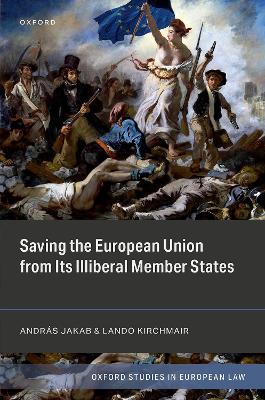
This is not only the crispest analysis of the EU constitutional crisis to date, but, above all, a work full of innovative institutional proposals how to solve it. * Christoph Möllers, Humboldt-University Berlin * A fascinating description of mutual poisoning: the growing illiberalism in EU member states poisons the EU and the poison of indifference enables the self-poisoning in the member state. The authors offer the antidote-and there is no intellectual excuse left not to take it. * Andrįs Sajó, Hungarian Academy of Sciences * The emergence of illiberal regimes within the European Union has triggered its most profound constitutional crisis to date. This book marks a significant and long-awaited advancement of the legal and political discussions regarding the nature of this crisis and potential solutions. It effectively challenges prevalent misconceptions and proposes practical institutional adjustments. * Armin von Bogdandy, Max Planck Institute for Comparative Public Law and International Law * The book is well laid out in seven chapters with logical sub-headings. There are useful introductory and concluding chapters too. It is also well annotated and indexed, with footnotes and a bibliography. A true work of scholarship. Delacroix's painting of 'Liberty Leading the People' (1830) on the book's cover symbolises the author's enlightened objectives. * David Glass, The Law Society Gazette * Recommended. Advanced undergraduates through faculty. * P. Kurzer, CHOICE *
1: Legal Institutionalism as a Conceptual Frame for Understanding and
Confronting the Current EU Illiberal Regime Crisis 2: The Emergence of
Illiberal Regimes in Post-Socialist European Union Member States 3: Deficits
and Erosion of Democracy and the Rule of Law in European Union Institutions
4: On the Mutual Dependence of the Rule of law and Democracy at both EU and
Member State levels 5: Adjusting an Existing Epistemological Tool: How to
Transform the European Union Justice Scoreboard into an Actual Rule of Law
Index 6: Completing the European Fundamental Rights Union: Applying the
Charter of Fundamental Rights to Purely Domestic Cases 7: Applying the
Spitzenkandidaten-system: How to Address the Illiberal Regime Crisis by
Improving Democratic Accountability
Andrįs Jakab is a Professor of Constitutional and Administrative Law at the University of Salzburg (on leave) and a Judge at the European Court of Human Rights. Formerly, he held various research and teaching positions in Budapest, Madrid, Liverpool, Nottingham, and Heidelberg. He also held a number of visiting and temporary positions in Milan, Luxembourg, Vienna, Heidelberg, and Budapest. His main research areas are constitutional law, European law, legal theory, and comparative law. He has a special research interest in the erosion of the rule of law and democracy.
Lando Kirchmair is a Deputy Professor at the University of the Bundeswehr in Munich. Formerly, he held various research and teaching positions in Salzburg, Rio de Janeiro, and Budapest and he also worked in different legal jobs in Strasbourg and Vienna. His main research areas are in international law, European law, public law, and legal philosophy. He has special research interests in the interplay between the international, EU, and member state legal orders as well as law and interdisciplinarity.