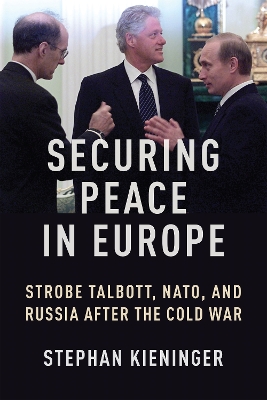
My longtime friend Strobe Talbott has had an extraordinarily influential career as a journalist, statesman, and scholar. I was fortunate to see his genius at work, first when we were roommates at Oxford when he was translating and editing Nikita Khrushchevs memoirs and then when he joined my administration, first to oversee our policy on Russia and the states of the former Soviet Union, then from 1994 to 2001 as deputy secretary of state. Securing Peace in Europe digs deep into Strobes thinking, shows just how brilliantly his mind worked, and delivers valuable insights into why Eastern Europe looks the way it does now. -- President Bill Clinton Kieninger highlights the crucial role Strobe Talbott played in seeking to integrate post-Soviet Russia into Western structures and create a European security architecture in which Russia had a stake. Essential reading for understanding why these policies ultimately failed and how Putins rise to power doomed Talbotts important efforts to engage Moscow. -- Angela Stent, author of Putin's World: Russia Against the West and with the Rest Kieninger offers an insightful account of American policy toward Russia, Ukraine, NATO, and the Kosovo crisis during the turbulent 1990s, told from the perspective of Strobe Talbott, President Bill Clinton's key advisor on those issues. This rich history explains US hopes for building a post-Cold War European security architecture and why the Russia piece fell short. -- Steven Pifer, former US ambassador to Ukraine Stephan Kieninger has done a splendid job of examining US policy toward the former Soviet Union during the eight years of President Bill Clinton's administration and setting this in the context of the remarkable career of Strobe Talbott, the one-time translator and prominent journalist who became Clinton's most influential adviser on foreign affairs. This book is crucial for anyone wanting to understand how US foreign policy developed after the Cold War ended. -- Mark Kramer, Harvard University Kieninger offers fresh perspectives on the evolution of Europe's post-Cold War security system and America's role in it, taking Strobe Talbott as a prism to analyze the ups and downs in the process. This nuanced and deeply researched book investigates how the Clinton Administration sought to include Russia at every stage. Essential reading for anyone with an interest in the vexed search for a new NATO-Russia relationship after the end of the Cold War. -- Wolfgang Ischinger, former German ambassador to the United States and the United Kingdom, former chairman of the Munich Security Conference (20082022) Drawing on a multitude of previously untapped US sources including memos, letters, and diaries, Kieningerby foregrounding Strobe Talbotts key role as Americas foremost diplomat and Russia handhas written an excellent, exhaustively researched, and highly illuminating study on the Clinton administrations efforts to forge a sustainable post-Wall European security order. -- Kristina Spohr, author of Post Wall, Post Square: Rebuilding the World After 1989 Illuminating and deeply researched... * Survival * Kieningers book presents a unique window on the amply covered period of U.S. foreign policy following the disintegration of the Soviet Union, and especially on the enlargement of NATO. -- Maria Lipman * Foreign Affairs *