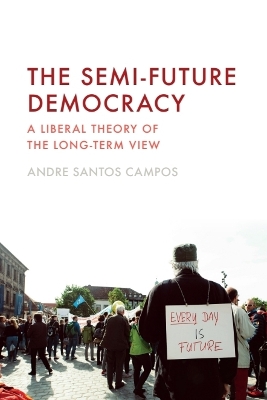
Explores whether liberal democracies can govern legitimately for the long term
Traditional institutions are often considered inadequate to govern for the long term as their politicians promote short-term thinking which can harm the future. This book proposes a novel theory of social time perception to address the short-term thinking of traditional institutions which threaten to stifle liberal democracies. The semi-future reconfigures liberal democracies’ franchises, representative instruments, deliberative practices, accountability mechanisms, and policymaking to include in the demos all citizens, regardless of age, and holders of representable objective interests in the future. The result is not only a way to legitimise long-term governance but also to improve the quality of current democracies.
Arvustused
This is a rich, innovative and important book on the potential for making democratic institutions more sensitive to the interests of future generations. Taking normative commitments to democratic legitimacy seriously, Santos Campos shows how we can avoid myopic electoral politics on the basis of new democratic understandings of time and political representation. -- Ludvig Beckman, Stockholm University How to promote justice, legitimacy and sustainability across generations is one of the most important questions currently facing humanity. Santos Campos stimulating book provides a rich and sophisticated discussion, together with a set of innovative positive proposals. Required reading. -- Stephen Gardiner, University of Washington
Introduction: Facing the Democratic Temporal Puzzle
Part I Democracy and the Long-Term View
Chapter 1: Multitemporal Democracy: The Balance Between the Short Term and
the Long Term
Chapter 2: Bringing the Future into the Present: The Legitimacy Gap in
Non-Overlapping Contexts
Part II The Semi-Future Polity
Chapter 3: The Semi-Future Temporal Order: A Novel Form of Presentism
Chapter 4: Semi-Future Representation: Justifying Responsiveness to Objective
Interests in the Future
Chapter 5: Semi-Future Accountability: The Ways of Responsibility and
Reflexivity Towards the Future
Chapter 6: Semi-Future Policymaking: The Implementation of Long-Term
Democratic Governance
Epilogue: Future-Oriented Democratic Theory
Acknowledgements
Bibliography
Andre Santos Campos is a Research Fellow in Political Theory at the Nova University of Lisbon. His research concentrates on issues that connect contemporary political theory with jurisprudence and intellectual history, especially democratic theory and intergenerational justice. He is the author of Spinozas Revolutions in Natural Law (2012). He is also the editor of Machiavellis Discourses on Livy: New Readings (2021), Sovereignty as Value (2021), Spinoza and Law (Routledge, 2016), Spinoza: Basic Concepts (2015), and Challenges to Democratic Participation (2014). In 2019, he was the recipient of the Brian Barry Prize in Political Science, attributed by The British Academy.