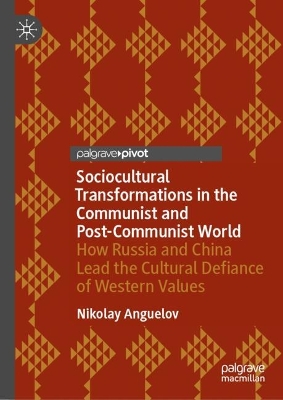
The continued popularity of Western, mainly American cultural exports internationally has given rise to The West and the Rest paradigm as a defining feature of cultural globalization. This volume explains The West and the Rest paradigm and follows its legacy with analysis of the development of the concepts of cultural globalization, cultural convergence, and their continued proliferation in authoritarian dictatorships, despite strong government censorship. It explains this trajectory in the context of technological innovations that have fueled the evolution of cross-border cultural messaging. This messaging continues to proliferate via largely illicit citizen-managed markets that keep developing ways to evade the censorship of central governments in the remnants of the Communist world. Its popularity with ordinary citizen keeps growing because of showing higher standards of living and well-being. Citizens embrace it as an escapist mechanism and this embrace is analyzed as an outcome of soft power. The dynamic is discussed on two fronts in this volume. One is with a focus on the technological innovations since the end of the Cold War that have increased the breadth, scope, and source of cross-cultural messaging. The other is with a focus on the evolution of the economic structure of the former Communist world. Wealth and digitization are congruent and therefore, a parallel lesion discussion is offered on the change of economic realities of the last decades of Communism and today. The change is the significant growth of wealth in the former Communist world. Authoritarian governments are deploying it in their own soft power ways to promote their domestic and international clout and defy Western cultural and diplomatic pressures, including economic sanctions. This resilience is discussed with a focus on how Russia is withstanding the unprecedented economic sanctions imposed on it for its war on Ukraine. It does so with the help of its ideological allies, including North Korea and China, eager to support Russia in its defiance of Western values. The soft power of these autocratic power players is examined further in the context of the interplay between soft and sharp power. This interplay redefines formal and informal socio-cultural diplomacy. The book concludes with a detailed analysis of the change through a digital cosmopolitanism lens with a focus on user-generated technopolitical content.
Chapter 1: The Legacy and Counter Response to Western Cultural Exports
in post-Communist Transitions.
Chapter 2: The Rise of Russian Propaganda in
the Remnants of the Communist World.
Chapter 3: Illicit Cultural
Globalization, Underground Economy and Networks in a Digital World.
Chapter
4: The Soft Power Tactics of Autocrats.
Chapter 5: The Cultural Convergence
Debate.
Chapter 6: Conclusion.
Dr. Nikolay Anguelov is Full Professor of Public Policy at the University of Massachusetts, Dartmouth. He has a Ph.D. in Policy Studies, concentration Regional Economic Development, an MPA and an MS in Applied Economics and Statistics from Clemson University. Dr Anguelov completed his undergraduate studies at the Fashion Institute of Technology where he earned a double B.S. in International Trade and Advertising Communications and Marketing. As a political economist, he focuses on the intersection of economics and politics, both in the US and internationally. His research links economic development, globalization, sustainability, and public finance. He is the author of five books: The Sustainable Fashion Quest: Innovations in Business and Policy (2021, Routledge), From Criminalizing to Decriminalizing Marijuana: The Politics of Social Control (2018, Lexington Books), The Dirty Side of the Garment Industry: Fast Fashion and Its Negative Impact on Environment and Society (2015, CRC Press), Economic Sanctions Vs. Soft Power: Lessons from North Korea, Myanmar and the Middle East (2015, Palgrave Macmillan) and Policy and Political Theory in Trade Practice: Multinational Corporations and Global Governments (2014, Palgrave Macmillan). He is also contributing author and co-editor of Stoneover: The Observed Lessons and Unanswered Questions of Cannabis Legalization (2022, Lexington Books.