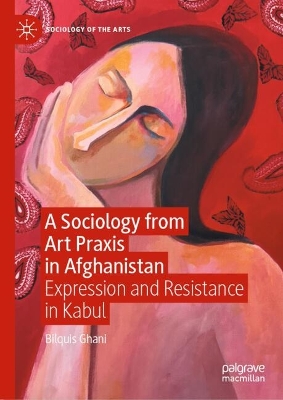
This book examines the transformative potential of arts on Afghan society, specifically focusing on how artistic praxes have shaped and influenced social dynamics and identity. Theorising sociocultural responses to military interventions, political instability and upheaval, this book delves into the concept of artistic praxis as a sociological tool. Including interviews with male and female Afghan artists, it explores their experiences and creations to contribute to a deeper understanding and constructions of society within the artistic ecologies in Afghanistan. This book explicates the nuances of gender conceptualisation in artistic expression. Challenging traditional and reductive depictions of masculinity, this book foregrounds feminisms and masculinity rooted in the contexts of the Global South. Filling a crucial gap in the limited literature on Afghan arts and artists, a section is devoted to the period since the Taliban take-over in August 2021. This book will be of importance to students and scholars interested in the intersections of sociology, arts, decolonial studies, gender and feminist studies, diaspora studies, as well as peace and conflict studies.
Chapter 1: Introduction.- PART ONE: Enchantment and Encounter.
Chapter
2: Why Art?.
Chapter 3: Art as Counter-narrative.- PART TWO: Contextualising
Gender.
Chapter 4: Feminism as Praxis.
Chapter 5: Complex Masculinity,
Postcolonial Masculinity.- PART THREE: People and Place.
Chapter 6: From the
Same Blue Planet.
Chapter 7: Kabul - A Tale of Two Cities.- PART FOUR:
Thresholds of Violence.
Chapter 8: Conclusion.
Bilquis Ghani is Lecturer at the School of Arts and Communication of the University of Canberra, Australia. Interested in art's public pedagogy potential, she focuses in her research on the mobilisation of the creative process through periods of social and cultural rupture. Drawing on her lived experience as an Afghan living in diaspora and her family lineage in the arts, Bilquis takes a decolonial approach in her research on arts movements in conflict spaces. She founded and has chaired the Hunar Symposia to decolonise the arts, which explores the intersections of art and conflict and creates opportunities for discourse between academics, arts practitioners and collectives.