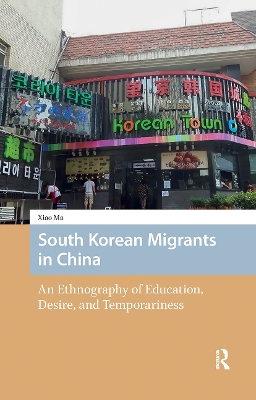
China as a new destination for immigration; New wave in Korean diaspora; Transient Migration and education in East Asia China as a new destination for immigration; New wave in Korean diaspora; Transient Migration and education in East Asia This book is an ethnographic account of education and migration from the perspective of three groups of South Koreans in contemporary China: migrant parents, children/students, and educational agents. The book reveals how these temporary migrants make choices, plan their trajectories and engage with the authorities, both in China and South Korea. Migrant subjectivities among these groups are driven by and respond to the education-migration regimes of both the sending and receiving countries. As ‘people in between’, they occupy flexible and multiple positionalities that are transnationally distributed. However, paradoxically, they experience a juxtaposition of privilege, integration and separation, which is indicative of the Chinese style of internationalisation. The book adds weight to the argument that China is a temporary destination for foreigners and not one for long-term settlement.
List of Illustrations
Chapter One: Introduction
Chapter Two: Temporary Residents Community in Beijing
Chapter Three: The Internationalised Education of China and the Globalised
Education of South Korea
Chapter Four: Educational Desire in School Choice: Identities of Home,
Destination and the World
Chapter Five: Desirable Homecoming: The Pursuit of Tertiary Education in the
Context of Temporary Migration Regimes
Chapter Six: Internationalisation in Chinese Education: The Quest for Entry
to a Top Chinese University
Chapter Seven: Conclusion
Index
Xiao Ma is an assistant professor in sociology at East China University of Science and Technology in Shanghai. She received her PhD from Leiden University Institute for Area Studies, the Netherlands. Her research interests include migration and education, ethnic community and economy, and immigration governance in China.She publishes in Journal of Ethnic and Migration Studies, The Asia Pacific Journal of Anthropology, and Identities.