Muutke küpsiste eelistusi

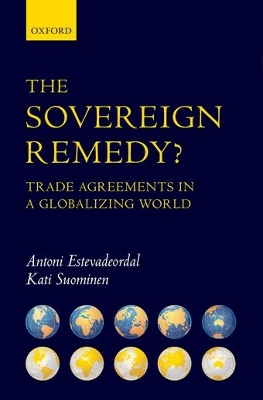
Sovereign Remedy?: Trade Agreements in a Globalizing World [Kõva köide]

(Manager, Integration and Trade Sector, Inter-American Development Bank), (International Trade Specialist, Integration and Trade Sector, Inter-American Development Bank)
  • Formaat: Hardback, 282 pages, kõrgus x laius x paksus: 241x162x18 mm, kaal: 635 g, tables and figures
  • Ilmumisaeg: 23-Apr-2009
  • Kirjastus: Oxford University Press
  • ISBN-10: 0199550158
  • ISBN-13: 9780199550159
Teised raamatud teemal:
  • Kõva köide
  • Hind: 129,30 €*
  • * hind on lõplik, st. muud allahindlused enam ei rakendu
  • Tavahind: 161,62 €
  • Säästad 20%
  • Raamatu kohalejõudmiseks kirjastusest kulub orienteeruvalt 3-4 nädalat
  • Kogus:
  • Lisa ostukorvi
  • Tasuta tarne
  • Tellimisaeg 2-4 nädalat
  • Lisa soovinimekirja
  • Raamatukogudele
    • Oxford Scholarship Online e-raamatud
  • Formaat: Hardback, 282 pages, kõrgus x laius x paksus: 241x162x18 mm, kaal: 635 g, tables and figures
  • Ilmumisaeg: 23-Apr-2009
  • Kirjastus: Oxford University Press
  • ISBN-10: 0199550158
  • ISBN-13: 9780199550159
Teised raamatud teemal:
International trade and the rapidly proliferating network of trade agreements have aroused passions for decades. While some blame trade agreements for exporting jobs, sowing poverty, furthering illegal migration, and robbing national sovereignty, others praise them as lynchpins of growth, pillars of peace, guarantors of security, and engines of globalization. Still others view them as useful instruments for fostering global trade and investment. This book examines whether trade agreements merit the blame levelled against them or the hopes pinned on them. It employs extensive new historical data on trade agreements to examine the features of the ongoing trade agreement wave; analyzes the future implications of trade agreements in the context of the multilateral trading system, world trade, and international politics; and puts forth novel policy proposals to make trade agreements a more constructive force in the global economy.
Abbreviations xi
Introduction
3(14)
The Proliferation of Trade Agreements: New Policy Questions
3(3)
Organization and Main Findings
6(11)
Part I. The Rise of Trade Agreements
Tides of Trade Integration
17(67)
Introduction
17(2)
Trade Agreements Through Time
19(33)
Why Trade Agreements?
52(11)
Conclusion
63(21)
Cooperating to Trade, Trading to Cooperate
84(25)
Introduction
84(2)
Evolution of International Cooperation
86(6)
Trade and Cooperation: Is There a Nexus?
92(11)
Conclusion
103(6)
Intricate Designs: The Architecture of Trade Agreements
109(48)
Introduction
109(1)
Sectoral Dynamics
110(21)
``Trade-Related'' Rules
131(10)
Beyond Rule-Making
141(1)
Conclusion
142(15)
Part II. What Future for Trade Agreements?
Disciplining Trade Agreements: Toward Multilateralization?
157(32)
Introduction
157(2)
Preferential Trade Agreements and the Multilateral Trading System: Friends or Foes?
159(22)
Toward Global Free Trade: What Are the Options?
181(6)
Conclusion
187(2)
Managing the Spaghetti Bowl of Trade Agreements
189(35)
Introduction
189(3)
Conceptualizing Convergence
192(17)
Feasibility of Convergence across PTAs around the World
209(9)
Conclusion
218(6)
Conclusion: Making More of Trade Agreements
224(12)
Introduction
224(4)
Managing Trade Challenges: Global and National Measures
228(7)
Conclusion
235(1)
Bibliography 236(15)
Index 251
Antoni Estevadeordal is currently the Manager of Integration and Trade Sector at the Inter-American Development Bank. He has expertise in trade policy, economic integration and regional cooperation policies in Latin America and the Caribbean, Asia and Europe, and has contributed to multiple Bank operations, in particular in the design of new programming instruments and financial products to support trade development and regional integration initiatives. Before joining the IDB he taught at the University of Barcelona and Harvard University and has published widely in major journals. He holds a Ph.D. in Economics from Harvard University and a B.A. in Economics from the University of Barcelona.

Kati Suominen has served since 2003 as International Trade Specialist at the Inter-American Development Bank in Washington, where she leads team research projects on global and preferential trade integration, and coordinates inter-institutional initiatives with other international institutions, including the World Trade Organization. She holds a PhD in Political Science and International Relations from the University of California, San Diego and an MA in International Relations from Boston University.