Muutke küpsiste eelistusi

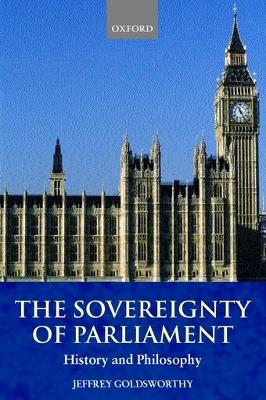
Sovereignty of Parliament: History and Philosophy [Pehme köide]

(Professor of Law, Monash University, Australia)
  • Formaat: Paperback / softback, 330 pages, kõrgus x laius x paksus: 233x156x28 mm, kaal: 512 g
  • Ilmumisaeg: 12-Jul-2001
  • Kirjastus: Oxford University Press
  • ISBN-10: 0199248087
  • ISBN-13: 9780199248087
Teised raamatud teemal:
  • Pehme köide
  • Hind: 62,88 €*
  • * hind on lõplik, st. muud allahindlused enam ei rakendu
  • Tavahind: 78,60 €
  • Säästad 20%
  • Raamatu kohalejõudmiseks kirjastusest kulub orienteeruvalt 3-4 nädalat
  • Kogus:
  • Lisa ostukorvi
  • Tasuta tarne
  • Tellimisaeg 2-4 nädalat
  • Lisa soovinimekirja
  • Raamatukogudele
    • Oxford Scholarship Online e-raamatud
  • Formaat: Paperback / softback, 330 pages, kõrgus x laius x paksus: 233x156x28 mm, kaal: 512 g
  • Ilmumisaeg: 12-Jul-2001
  • Kirjastus: Oxford University Press
  • ISBN-10: 0199248087
  • ISBN-13: 9780199248087
Teised raamatud teemal:
The doctrine of parliamentary sovereignty has long been regarded as the most fundamental element of the British Constitution. It holds that Parliament has unlimited legislative authority, and that the courts have no authority to judge statutes invalid. This doctrine has now been criticized on historical and philosophical grounds and critics claim that it is a relatively recent invention of academic lawyers that superseded an earlier tradition in which Parliament's authority was limited to common law. The critics also argue that it is based on a misunderstanding of the relationship between statutory and common law, and is morally indefensible. The Sovereignty of Parliament: History and Philosophy responds to these criticisms. It first defines and clarifies the concept of legislative sovereignty and then describes the historical origins and the development of the doctrine from the thirteenth to the end of the nineteenth century. Professor Goldsworthy goes on to identify many different reasons why persuaded statesmen, lawyers, and political theorists have endorsed the doctrine. He discusses the ideas of a large number of legal and political thinkers, including Fortescue, St German, Hooker, Coke, Bacon, Parker, Milton, Hobbes, Hale, Locke, Bolingbroke, Blackstone, and Burke. He shows that judges in Great Britain have never had authority to invalidate statutes, and that the doctrine is much older than is generally realized. The book concludes by dealing with philosophical criticisms of the doctrine. Combining the insights of earlier thinkers with those of contemporary legal philosophers, it demonstrates that these criticisms are based on a defective understanding of the nature and foundations of law, and of the relationship between legislative authority and the common law. It argues that the doctrine is morally defensible, and refutes the thesis that the judges have authority to modify or reject it.

Arvustused

... Goldsworthy provides a brilliant survey of parliamentary sovereignty in England and how the theory and the institution evolved and altered over time. In a masterful recitation of historical legal cases, statutory law, and philosophical theory Goldsworthy provides the case for parliamentary sovereignty from Bracton through Blackstone and the nineteenth century. ... his clean, uncluttered prose knits together the analysis of the cases with contemporary political philosophy to make a most readable text from dense material. He has done a superb job. * American Journal of Legal History, January 2000 * Review from previous edition Goldsworthy's use of secondary sources and his scholarship are admirable. The style may be elusive, but it is nonetheless very readable and his arguments in the chapter dedicated to the philosophical foundations of the doctrine are clearly written and accesible. * THES *

Introduction
1(8)
Defining Parliamentary Sovereignty
9(13)
`Parliament' and `Sovereignty' Defined
9(7)
Sovereignty and `Higher Law'
16(6)
From Bracton to the Reformation
22(29)
Medieval Kingship, Law, and Politics
22(6)
Parliament and its Authority
28(10)
Parliament as a Law-Maker
38(6)
Parliament and the Courts
44(2)
Parliament in Legal Theory
46(2)
Parliament and the Church
48(3)
The Sixteenth Century
51(27)
The Authority of Parliament Extended
51(7)
The Supremacy of Parliament Recognized
58(5)
Two Theories of the Authority of Parliament
63(2)
Royalist Theories
65(2)
Parliamentarian Theories
67(8)
Prelude to the Seventeenth Century
75(3)
From James I to the Restoration
78(64)
Political Theories in Early Stuart England
78(1)
Royalist Theories of the Authority of Parliament
79(17)
Parliamentarian Theories of the Authority of Parliament
96(13)
Common Law Theories of the Authority of Parliament
109(15)
Parliamentary Sovereignty Affirmed
124(11)
The Interregnum
135(7)
From the Restoration to the Revolution
142(17)
Monarchist Ideologies
142(7)
Whig Ideology
149(10)
After the Revolution
159(62)
Whig and Tory Consensus
159(6)
The Union of England and Scotland
165(8)
Legal Sovereignty, Popular Sovereignty, and the Right of Resistance
173(15)
Law-Making Power and Constitutional Principle
188(4)
British Opinion during the American Crisis
192(5)
Judicial Opinion and Legal Theory
197(7)
American Revolutionary Constitutional Theory
204(11)
The Reform Movement in Britain
215(6)
The Nineteenth Century
221(8)
Historical Conclusions
229(7)
The Philosophical Foundations of Parliamentary Sovereignty
236(45)
Parliamentary Sovereignty and Legal Philosophy
236(1)
Law as the Foundation of Law-Making Authority
236(2)
The Common Law as the Foundation of Law-Making Authority
238(8)
Legal Principles as the Foundation of Law-Making Authority
246(4)
The Practice of British Officials
250(3)
Official Consensus as the Foundation of Law-Making Authority
253(6)
The Argument From Extreme Cases
259(13)
Further Arguments
272(5)
The Alleged Necessity of Judicially Enforceable Constitutional Rights
277(4)
References 281(30)
Index of Names and Index of Subjects 311


Professor Jeffrey Goldsworthy is Professor of Law at Monash University, Australia