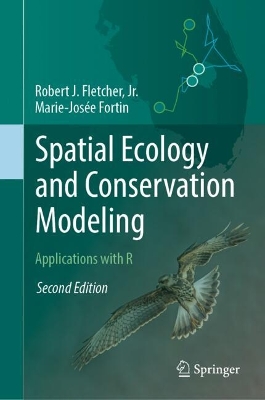
This book provides a foundation for modern applied ecology. Much of current ecology research and conservation addresses problems across landscapes and regions, focusing on spatial patterns and processes. This book is aimed at teaching fundamental concepts and focuses on learning-by-doing through the use of examples with the software R. It is intended to provide an entry-level, easily accessible foundation for students and practitioners interested in spatial ecology and conservation.
The second edition of this popular textbook follows a rapidly changing field with updates of concepts, methods, and code. New chapters include topics on movement ecology and conservation planning, with an improved link between spatial modeling and applied conservation throughout the book.
Introduction to spatial ecology and conservation.- Scale.- Land-cover
pattern and change.- Spatial dispersion and point process data.- Spatial
dependence.- Accounting for spatial dependence in ecological data.- Species
distributions.- Space use and resource selection.- Movement.- Connectivity.-
Spatially structured population dynamics.- Spatially structured communities.-
Spatial prioritization and conservation planning.- What have we learned?
Looking back and pressing forward.
Robert J. Fletcher, Jr., is the Miriam Rothschild Professor of Conservation Biology at the University of Cambridge. His research interests include landscape and spatial ecology, conservation biology, population biology, animal behavior, and quantitative modeling.
Marie-Josée Fortin is professor of Spatial Ecology at the University of Toronto, fellow of the Royal Society of Canada, and Web of Science Highly Cited Researcher in Environment/Ecology. Her research interests are at the interface of ecology, conservation, and spatial statistics.