Muutke küpsiste eelistusi

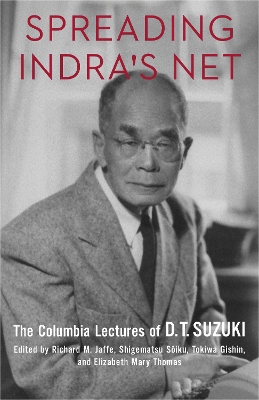
Spreading Indra's Net: The Columbia Lectures of D. T. Suzuki [Kõva köide]

  • Formaat: Hardback, 384 pages, kõrgus x laius: 216x140 mm, 18 figures
  • Ilmumisaeg: 26-Aug-2025
  • Kirjastus: Columbia University Press
  • ISBN-10: 023119286X
  • ISBN-13: 9780231192866
Teised raamatud teemal:
  • Kõva köide
  • Hind: 34,80 €*
  • * hind on lõplik, st. muud allahindlused enam ei rakendu
  • Tavahind: 43,50 €
  • Säästad 20%
  • Raamatu kohalejõudmiseks kirjastusest kulub orienteeruvalt 3-4 nädalat
  • Kogus:
  • Lisa ostukorvi
  • Tasuta tarne
  • Tellimisaeg 2-4 nädalat
  • Lisa soovinimekirja
  • Formaat: Hardback, 384 pages, kõrgus x laius: 216x140 mm, 18 figures
  • Ilmumisaeg: 26-Aug-2025
  • Kirjastus: Columbia University Press
  • ISBN-10: 023119286X
  • ISBN-13: 9780231192866
Teised raamatud teemal:
D. T. Suzuki’s 1950s lectures at Columbia University were foundational for the postwar Zen boom. Speaking in a soft voice in a bookcase-lined room, Suzuki, then in his eighties, introduced East Asian Buddhism to a rapt audience of the general public, scholars, and students. He offered a distinctive interpretation of Zen, weaving together his understanding of classical Buddhist texts, especially the Flower Garland Sutra, with Christian mysticism, psychology, and twentieth-century European and American philosophy. The freewheeling lectures captivated an audience drawn from the New York intelligentsia and art world—including Carolyn Brown, John Cage, Arthur Danto, Sari Dienes, Erich Fromm, Phillip Guston, Ibram Lassaw, and Dorothy Norman—and catalyzed public interest in Buddhism.

Spreading Indra’s Net presents Suzuki’s 1952–1953 lectures in full, giving a vivid look at how one of the most important global Buddhist figures of the twentieth century interpreted Zen for an American audience. Drawing on archival research in Japan and the United States, editor Richard M. Jaffe provides an extensive introduction that traces Suzuki’s path to Columbia, analyzes the content of the lectures, and surveys their reception. Among the most accessible works of a major figure and a record of a crucial moment in New York history, this book displays Suzuki’s gifts as a teacher, scholar, writer, and thinker.

Spreading Indra’s Net presents D. T. Suzuki’s 1952–1953 lectures at Columbia University in full, giving a vivid look at how one of the most important global Buddhist figures of the twentieth century interpreted Zen for an American audience.

Arvustused

Spreading Indras Net is a celebration of primary-source research and the use of archivesJaffes book sharpens our understanding by focusing on the formative New York community of learners and supporters who were so captured by his teachings. * Tricycle * D. T. Suzukis legendary Columbia University lectures position Zen as a lively, iconoclastic, art-friendly, and experiential form of spirituality. Scholar-sleuth Richard Jaffe uncovered a set of almost verbatim lecture notes, providing, for the first time, access to one of the key documents in the transmission of Zen to the West, and his well-researched introduction gives us the moment. -- Norman Fischer, poet, Soto Zen priest, and founder of Everyday Zen Foundation Suzukis momentous 195253 seminars on Buddhist philosophy captivated his Columbia University audience, and his unique ideas, insights, and interpretations remain alluring. Now we get to join that audience thanks to Jaffes fine introduction and labor of love to make these texts available. -- Evan Thompson, author of Waking, Dreaming, Being: Self and Consciousness in Neuroscience, Meditation, and Philosophy An illuminating look into D.T. Suzukis first lectures at Columbia University and a clear biographical vision of this renowned Zen scholar and philosopher. Jaffe offers a path to the mind of the teacher and a thorough read of lectures believed by artists and art historians to be a vital root of creative innovation that deeply influenced the art of the 1950s and beyond. -- Jennie Kiessling, studio artist and art educator Admired by philosophers, artists, literary figures, psychologists, and spiritual seekers, Daisetz Suzuki played a unique role in the dissemination of Buddhism to the modern West. Spreading Indras Net displays his ingenuity in communicating Zen through the varied idioms of mid-twentieth century thought and the reasons for his enduring appeal. Richard Jaffe's introductory essay is impressive and illuminating and puts into context what made D.T. Suzuki so attractive. -- Jacqueline Stone, author of Original Enlightenment and the Transformation of Medieval Japanese Buddhism Jaffes Introduction, meticulous and most interesting, is just right. The Suzuki lectures are replete with knowledge, conviction, andof all thingsindividual charm. This central, largely hidden event in the dissemination of Buddhism in the West is now an event for us all. -- Roger Lipsey, author of Politics and Conscience: Dag Hammarskjöld on the Art of Ethical Leadership

Abbreviations
Editorial Notes
Introduction: A Course with No Beginning
Daisetz Teitaro Suzukis Columbia University Seminar Lectures, 19521953
I
II
III
IV
V
VI
Character Glossary
Acknowledgments
Notes
Bibliography
Index
Richard M. Jaffe is professor of religious studies at Duke University. He is the general editor of the Selected Works of D. T. Suzuki and the author of Seeking Sakyamuni: South Asia in the Formation of Modern Japanese Buddhism and Neither Monk nor Layman: Clerical Marriage in Modern Japanese Buddhism.

Shigematsu Siku is abbot of the Rinzai Zen temple Shgenji in Shizuoka, Japan. He is the editor-translator of A Zen Forest: Sayings of the Zen Masters and the cotranslator of D. T. Suzukis Columbia University Seminar Lectures into Japanese.

Tokiwa Gishin is emeritus professor at Hanazono University. He is the translator of Zen and the Fine Arts and the cotranslator of D. T. Suzukis Columbia University Seminar Lectures into Japanese.

Elizabeth Mary Thomas (19071986) was an accomplished Egyptologist who regularly attended Suzukis seminars. The manuscript that she compiled based on her remarkably detailed class notes forms the basis of this book.