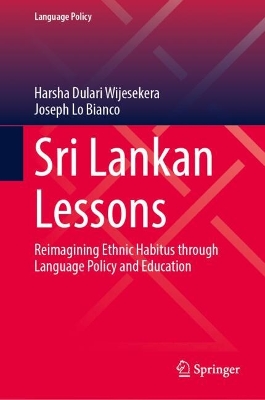
This book analyses the post-conflict reality of language policy and planning in Sri Lanka. It examines and interprets how socio-politically and economically driven decisions, shaped by both exogenous and endogenous factors, have demonstrably generated negative socially situated conditions that exacerbate existing struggles in state-building in Sri Lanka. The book takes a kaleidoscopic view of the mixed implications of mother-tongue instruction and bilingual education through application of a Bourdieusian lens.
In light of the legacies and influence of the bitter civil disruptions of the latter part of the 20th century, especially a 30 year-long ethnic conflict in which language education settings were a regular feature of dissent and conflict, compromise and innovation, the volume looks at Language Policy and Planning in education, with reference to the wider socio-political context of ethnic relations and post-colonial reconstruction.
This book is of interest to sociologists of language, education and peacebuilding, conflict analysts, development studies personnel and political scientists, as well as university students, linguistic anthropologists, researchers, and language policy planners.
chapter one: why sri lanka matters: language policy, nation building
and conflict mitigation.- chapter two: laws, language and discourse: sri
lankas colonial and immediate post-colonial transition period.- chapter
three: understanding change.- chapter four: realigning ethnic habitus in the
multiethnic be pedagogic field.- chapter six: linguistic market and ethnic
habitus shaping in multiethnic be field.- chapter seven: ways forward:
language policy implications and reflections on reconciliation and
peacebuilding.
Harsha Dulari Wijesekera started her teaching career as a teacher in public schools in Sri Lanka. This was followed by working in state, private and military universities. She worked with multiethnic and multilingual students in public schools and public/private universities before pursuing her Ph.D. at the Queensland University of Technology. Presently, she works as a Senior Lecturer at the Postgraduate Institute of English, Open University of Sri Lanka. Her research interests include education, social/ethnic cohesion, English language teaching, teacher education, and sociology of education. Recently, she conceptualized, designed and implemented the first-ever Postgraduate Diploma in Bilingual Education, with the aim of addressing teacher education issues in teaching content subjects through English (BE), which was fully funded by the Ministry of Education, Sri Lanka.Joseph Lo Bianco is Professor of Language and Literacy Education in the Melbourne Graduate School of Education at the University of Melbourne, and a past president of the Australian Academy of the Humanities. He specialises in language policy studies, bilingualism and intercultural education and research and action on peace and conflict in multi-ethnic settings. He was the author of the 1987 National Policy on Languages, recognised worldwide as the first multilingual policy in an English speaking society. In 1998 and 1999 he worked at the National Institute of Education in Sri Lanka on language policy and bilingual education. He has published on Sri Lankan language education policy and continued to travelled to and conduct research in Sri Lanka over the past two decades. He has been an invited consultant on solving language problems in education and in wider society in 25 countries since 1990 and has led major language education writing teams and research for major international organisations in Europe and Asia, such as LUCIDE, a 12-country municipal level study of multilingualism for the European Commission. Since 2012 he has directed a multi-country project on language policy and social cohesion in conflict affected settings in SE Asia for UNICEF and conducted large-scale policy workshops for high level policy officials across Asia, under the auspices of UNESCO. He has an extensive list of publications with a strong recent focus on social cohesion, peace and conflict mitigation in multi-ethnic settings.