Muutke küpsiste eelistusi

State Silence Across International Law: Meaning, Context, and Developments [Kõva köide]

Volume editor (Associate Professor of Law, University College London)
  • Formaat: Hardback, 394 pages, kõrgus x laius x paksus: 240x165x27 mm, kaal: 738 g
  • Ilmumisaeg: 28-May-2025
  • Kirjastus: Oxford University Press
  • ISBN-10: 0198912625
  • ISBN-13: 9780198912620
  • Kõva köide
  • Hind: 137,40 €*
  • * hind on lõplik, st. muud allahindlused enam ei rakendu
  • Tavahind: 171,75 €
  • Säästad 20%
  • Raamatu kohalejõudmiseks kirjastusest kulub orienteeruvalt 3-4 nädalat
  • Kogus:
  • Lisa ostukorvi
  • Tasuta tarne
  • Tellimisaeg 2-4 nädalat
  • Lisa soovinimekirja
  • Formaat: Hardback, 394 pages, kõrgus x laius x paksus: 240x165x27 mm, kaal: 738 g
  • Ilmumisaeg: 28-May-2025
  • Kirjastus: Oxford University Press
  • ISBN-10: 0198912625
  • ISBN-13: 9780198912620
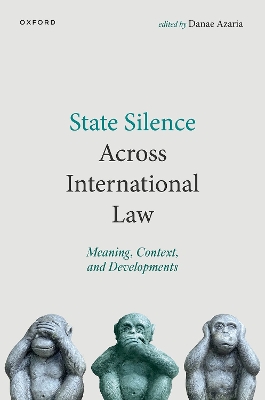
The words and actions of states have a significant influence on international law. But what of silence and inaction? During the twentieth and twenty-first century, the framework of international law underwent profound transformation. As a result, the contexts in which State silence may be interpreted have become complex and are not well understood. In light of these new realities, this ground-breaking volume explores the evolving legal meaning and effects of State silence in international law-making.

Across sixteen chapters, this book questions the circumstances that necessitate a State's reaction, the factors influencing a State's ability to respond, and how a period of silence should be assessed. It also investigates whether and how the shift in international law from bilateralism towards community interests, multilateralism, intergovernmental institutions, and expert bodies, including international courts and tribunals, affect the interpretation of State silence. Furthermore, it probes whether and how advancements in communication, the increased number of States, and their diverse characteristics influence this interpretation.

Examining these issues across multiple facets of international law, the book demonstrates the ubiquity of State silence and its legal significance in different fields, and the contextual factors that come together to interpret State silence in a particular instance. Through this exploration, the broad question of state silence's role in either maintaining stability or enabling change is scrutinised.

Featuring contributions from twenty-one experts, State Silence Across International Law is a must read for anyone interested in understanding state silence as a factor across different areas of law, including peace and security, international humanitarian law, international criminal law, and international economic law, among others.

State Silence Across International Law examines the role of State silence and inaction in the formation of rules of international law. It explores how State silence can be interpreted in a range of contexts, including in relation to use of force, cyberspace, armed conflict, human rights, trade, boundaries, outer space, and the environment.

Arvustused

Masterfully conducted and put together by Danae Azaria, this outstanding collective research on the legal meaning of State silence across various fields of international law will be much talked about. While silence is always deeply contextual, giving it legal significanceor notultimately rests on commonsensical considerations that betray a certain understanding of social relations. Silence is thus not only crucial for what it means, but most importantly for what allows us to make it meaningful. In other words, State silence speaks volumes about the very possibility of law in the international community. * Pierre dArgent, University of Louvain *

Part
1. General 1: Danae Azaria: Introduction 2: Omri Sender and
Michael Wood: State Silence and the Work of the International Law Commission
Part
2. Peace and Security 3: Danae Azaria: State Silence and the Law on the
Use of Force 4: Duncan B. Hollis and Barrie Sander: State Silence and the
International Law of Cyberspace, 5: Sandesh Sivakumaran: State Silence and
the Law of Armed Conflict 6: Talita Dias: State Silence and International
Criminal Law Part
3. International Human Rights Law 7: Andreas Zimmermann
and Nils-Hendrik Grohmann: State Silence and the Framework of the ICCPR 8:
Olivia Coral Daniels and Laurence R. Helfer: State Silence and the European
Human Rights System Part
4. International Economic Law 9: Gabrielle Marceau
and Rebecca Walker: WTO Members' Silence and WTO Decision-Making 10: Robert
Howse: WTO Members' Silence and WTO Law 11: August Reinisch and Johannes
Tropper: State Silence and International Investment Law Part
5.
International Law of Spaces and the Environment 12: Giovanni Distefano and
Aymeric Hêche: State Silence and Territorial Title and Boundaries 13:
Jean-Marc Thouvenin: State Silence and the Law of the Sea 14: Lorenzo
Gasbarri: State Silence and International Space Law 15: Malgosia Fitzmaurice:
State Silence and International Environmental Law Part
6. Conclusion 16:
Danae Azaria: Conclusion
Danae Azaria Associate Professor of Law at the Faculty of Laws, University College London (UCL), and the Principal Investigator of the Starting Grant (State Silence) of the European Research Council. She is a laureate of the Guggenheim Prize in Public International Law for her monograph, Treaties on Transit of Energy via Pipelines and Countermeasures (OUP, 2015) and has published widely in international law. She holds and has held various prestigious editorial and advisory positions and visiting professorships. She is listed as an arbitrator in relation to various treaties, and she regularly advises governments and international organizations on issues of public international law.