Muutke küpsiste eelistusi

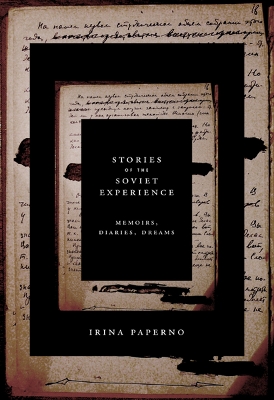
Stories of the Soviet Experience: Memoirs, Diaries, Dreams [Pehme köide]

  • Formaat: Paperback / softback, 304 pages, kõrgus x laius x paksus: 229x152x21 mm, kaal: 454 g
  • Ilmumisaeg: 15-Nov-2009
  • Kirjastus: Cornell University Press
  • ISBN-10: 0801475902
  • ISBN-13: 9780801475900
Teised raamatud teemal:
  • Formaat: Paperback / softback, 304 pages, kõrgus x laius x paksus: 229x152x21 mm, kaal: 454 g
  • Ilmumisaeg: 15-Nov-2009
  • Kirjastus: Cornell University Press
  • ISBN-10: 0801475902
  • ISBN-13: 9780801475900
Teised raamatud teemal:

Beginning with glasnost in the late 1980s and continuing into the present, scores of personal accounts of life under Soviet rule, written throughout its history, have been published in Russia, marking the end of an epoch. In a major new work on private life and personal writings, Irina Paperno explores this massive outpouring of human documents to uncover common themes, cultural trends, and literary forms. The book argues that, diverse as they are, these narratives—memoirs, diaries, notes, blogs—assert the historical significance of intimate lives shaped by catastrophic political forces, especially the Terror under Stalin and World War II. Moreover, these published personal documents create a community where those who lived through the Soviet era can gain access to the inner recesses of one another's lives.

This community strives to forge a link to the tradition of Russia's nineteenth-century intelligentsia; thus the Russian "intelligentsia" emerges as an additional implicit subject of this book. The book surveys hundreds of personal accounts and focuses on two in particular, chosen for their exceptional quality, scope, and emotional power. Notes about Anna Akhmatova is the diary Lidiia Chukovskaia, a professional editor, kept to document the day-to-day life of her friend, the great Russian poet Anna Akhmatova. Evgeniia Kiseleva, a barely literate former peasant, kept records in notebooks with the thought of crafting a movie script from the story of her life. The striking parallels and contrasts between these two documents demonstrate how the Soviet state and the idea of history shaped very different lives and very different life stories.

The book also analyzes dreams (most of them terror dreams) recounted in the diaries and memoirs of authors ranging from a peasant to well-known writers, a Party leader, and Stalin himself. History, Paperno shows, invaded their dreams, too. With a sure grasp of Russian cultural history, great sensitivity to the men and women who wrote, and a command of European and American scholarship on life writing, Paperno places diaries and memoirs of the Soviet experience in a rich historical and conceptual frame. An important and lasting contribution to the history of Russian culture at the end of an epoch, Stories of the Soviet Experience also illuminates the general logic and specific uses of personal narratives.


Paperno argues that, diverse as they are, these narratives—memoirs, diaries, notes, blogs—assert the historical significance of intimate lives shaped by catastrophic political forces, especially the Terror under Stalin and World War II.

Arvustused

"With this, her third magisterial book, the eminent literary and cultural historian Irina Paperno moves from Russia's nineteenth into the twentieth century, of which she was a denizen and which is now history. As usual, Paperno works at the elusive borderline between 'raw life' and the 'meaning(s)' born from its foam. The riveting interest of the stories told by history's participants is matched by the sophistication of the analyst."Alexander Zholkovsky, University of Southern California "The value and longevity of a book of personal 'stories' gathered from a traumatic eraand from a pool so vastdepends to a large extent on the scholarly wisdom, trustworthiness, and good taste of the gatherer. The stories must be singularly meaningful and at the same time representative; coherent for outsiders but not self-consciously crafted for them; and arranged under some unifying rubric that nevertheless does not depersonalize the subjects. Given the profusion of Soviet-era memoirs and diaries, such a book benefits from some new filter, information source, or angle of interpretation on the memory-material. Irina Paperno's Stories of the Soviet Experience satisfies all these criteria at the highest level. Who could have predicted that Russian e-journals would be inspired by great Stalin-era witnesses like Lydia Ginzburg, or that we could learn so much about the inner life of those times by tapping accounts of people's nightmares and dreams?"Caryl Emerson, A. Watson Armour III University Professor of Slavic Languages and Literatures, Princeton University "Irina Paperno in her book deals with a form of art in which the Russians have always exhibited particular talent: the writing of autobiographies, memoirs, and diaries. With the help of her insightful analysis and long excerpts from the texts, we can, as we never could before, gain some knowledge and understanding of how the Soviet people, or at least intellectuals, perceived what was happening to their country. Through the description of the lives of concrete individuals, some famous, some not well known, she makes a significant contribution to our knowledge of Soviet history."Peter Kenez, University of California, Santa Cruz, author of Birth of the Propaganda State; Soviet Methods of Mass Mobilization, 19171929

Acknowledgments ix
Introduction xi
PART I MEMOIRS AND DIARIES PUBLISHED AT THE END OF THE SOVIET EPOCH: AN OVERVIEW
1(56)
Publishers, Authors, Texts, Reader, Corpus
1(8)
The Background: Memoir Writing and Historical Consciousness
9(6)
Connecting the ``I'' and History
15(2)
Revealing the Intimate
17(7)
Building a Community
24(17)
Moving in with a New Text
Joining the Ranks of Victims
Remembering Stalin: Tears
Disagreeing
Family Memoirs
Two Memoirs and a Novel Tell the Same Story
Generalizations: Soviet Memoirs as a Communal Apartment
Writing at the End
41(8)
The Archive and the Apocalypse
The End of the Intelligentsia
Qualification: The ``I'' in Quotation Marks
49(2)
Excursus: Readers Respond in LiveJournal
51(4)
Concluding Remarks
55(2)
PART II TWO TEXTS: CLOSE READINGS
57(104)
Lidiia Chukovskaia's Diary of Anna Akhmatova's Life: ``Intimacy and Terror''
59(59)
The Years of Terror: In ``the Torture Chamber''
62(4)
Family and Home: ``The Cesspit of a Communal Apartment''
66(11)
Overview of Circumstances
The Apartment in Poems and Dreams
``To Have Dinner at the Same Table as Her Husband's Wife''
How Akhmatova Left Punin
Generalizations: The Soviet State, Domestic Space, and Intimacy
During the War
77(18)
Poverty and Squalor: New Living Forms and New Insight
The Helplessness and the Power
Gossip
Hardships and Privileges
``A New Epoch Began'': After 1953
95(20)
Did They Understand What Was Going On?
Akhmatova's Things and Manuscripts
An Aside: Memoirs as Historical Evidence
Historical Continuity: The 1930s and the 1960s
``Same Time, Same Facts, Different Memories''
Concluding Vignette: ``She'll Tell You What 1937 Was Like''
115(3)
The Notebooks of the Peasant Evgeniia Kiseleva: ``The War Separated Us Forever''
118(43)
Notebook I: ``The Story of My Life''
120(14)
The Separation and the War
The Second Marriage
After the Second Marriage
Here and Now
Notebooks 2 and 3
134(16)
Memory and Narrative
Television and Emotion
Television and Apocalypsis
A Comment on Historical Continuity: The Past War and the Future War
Generalizations: The Soviet State in the Domestic Space
Citizens and Power
The End: ``We Live Like Strangers''
How These Notebooks Reached the Reader: The Interpreters
150(9)
Defining the Status of the Text: ``Naive Writing''
The Competition between Publishers: ``Legislators and Interpreters''
The Disappearance of the Author
``Person without Subjecthood''
Concluding Remarks
159(2)
PART III DREAMS OF TERROR: INTERPRETATIONS
161(48)
Comments on Dreams as Stories and as Sources
161(5)
Andrei Arzhilovsky: The Peasant Raped by Stalin
166(5)
Nikolai Bukharin Dreams of Stalin: Abraham and Isaac
171(1)
Writers' Dreams: Mikhail Prishvin
172(10)
Writers' Dreams: Veniamin Kaverin
182(5)
The Dreams of Anna Akhmatova
187(7)
A Comment on Writers' and Peasants' Theories of Dreams
194(3)
A Philosopher's Dreams: Yakov Druskin
197(6)
Stalin's Dream
203(2)
Concluding Remarks
205(4)
Conclusion 209(2)
Epilogue 211(2)
Appendix: Russian Texts 213(46)
Notes 259(20)
Index 279
Irina Paperno teaches Russian literature and intellectual history at the University of California, Berkeley. Her publications include Suicide as a Cultural Institution in Dostoevsky's Russia, also from Cornell, and Chernyshevsky and the Age of Realism: A Study in the Semiotics of Behavior. She is coeditor of several books, including Creating Life: The Aesthetic Utopia of Russian Modernism.