Muutke küpsiste eelistusi

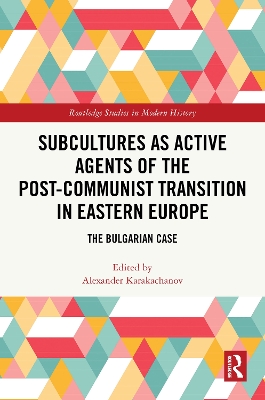
Subcultures as Active Agents of the Post-Communist Transition in Eastern Europe: The Bulgarian case [Kõva köide]

  • Formaat: Hardback, 226 pages, kõrgus x laius: 234x156 mm, 8 Tables, black and white; 4 Halftones, black and white; 4 Illustrations, black and white
  • Sari: Routledge Studies in Modern History
  • Ilmumisaeg: 22-Jun-2026
  • Kirjastus: Routledge
  • ISBN-10: 1041173849
  • ISBN-13: 9781041173847
Teised raamatud teemal:
  • Kõva köide
  • Hind: 159,19 €*
  • * hind on lõplik, st. muud allahindlused enam ei rakendu
  • Tavahind: 212,25 €
  • Säästad 25%
  • See raamat ei ole veel ilmunud. Raamatu kohalejõudmiseks kulub orienteeruvalt 3-4 nädalat peale raamatu väljaandmist.
  • Kogus:
  • Lisa ostukorvi
  • Tasuta tarne
  • Tellimisaeg 2-4 nädalat
  • Lisa soovinimekirja
  • Formaat: Hardback, 226 pages, kõrgus x laius: 234x156 mm, 8 Tables, black and white; 4 Halftones, black and white; 4 Illustrations, black and white
  • Sari: Routledge Studies in Modern History
  • Ilmumisaeg: 22-Jun-2026
  • Kirjastus: Routledge
  • ISBN-10: 1041173849
  • ISBN-13: 9781041173847
Teised raamatud teemal:
This edited volume explores the transformation of post-communist societies following the Bulgarian case in the period 1990s2010s. By identifying, analysing, and typologizing the subcultural groups that became active agents of social change in Eastern Europe, the book brings forth an integrative theory of social development.

Based on an interdisciplinary approach that combines the perspectives of Political Sciences, Sociology, Social History, and Social Anthropology, the volume creates a theoretical toolkit that offers an effective application of subcultural theory to theories of social development, social transformation, and social transitions. Organized into three parts, Part 1 analyses, on a macro, societal level, structural changes in societies, and how social change is sought commutatively and culturally. Part 2 presents five subcultures that can be identified as active subjects of social change in Bulgaria in the 1980s2010s. The political ones: the subculture of "Real socialism" (ex-communists, former communists) and the Anti-communism subculture, the economic ones of the "Mutri" and the subculture of "Honest businessmen" (new capitalists), and the cultural ones of the "Chalga/Popfilk". Part 3 mainly examines the social change in Bulgaria through the 'realms of memory'.

Subcultures as Active Agents of the Post-Communist Transition in Eastern Europe will be of interest to undergraduate students of East European Studies and Cultural Anthropology as well as practitioners working in the fields of cultural heritage, musical studies, archives, and libraries.
Introduction. Part
1. Integrative Theory of Social Development. Levels
of social change key notes
1. Macro (societal) level.
2. Meso
(intermediate) level.
3. Micro level. Part
2. Subcultures as active agents of
the post-communist transition in Bulgaria. Subcultures in Bulgaria.
4.
Political Subcultures in Bulgaria.
5. The Mutri subculture.
6. The new
businessmen subculture.
7. The Chalga/Popfolk subculture and the transition.
Part
3. 'Realms of memory' of subcultures in Bulgaria.
8. Communist monuments
in Sofia as lieux de mémoire for political subcultures during the
post-communist transition.
9. Street and institution names, city holydays,
and symbols.
10. Museumification of the traumatic memory of communism.
11.
The post-communist transition in perceptions of the young generations.
Alexander Karakachanov teaches political science and philosophical anthropology full-time at the University of Library Studies and Information Technologies and lectures part-time at Sofia University. He completed his Ph.D. at the Institute of Philosophy of the Bulgarian Academy of Sciences and has authored several publications, including Man and Consciousness (2011), Philosophy of Man (2014), and Current Issues in Political Science: Cultural- Anthropological Approach (2024).