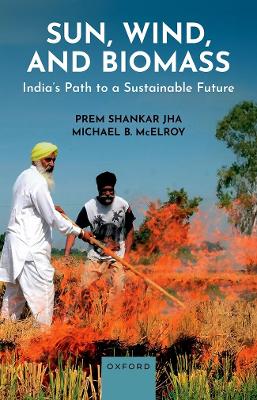
This book presents a comprehensive guide to India's pursuit of a clean energy future, exploring the economic and health benefits of transitioning from fossil fuels to renewable resources.
Sun, Wind, and Biomass: India's Path to a Sustainable Future examines the current state of the Indian economy, tracing its trajectory towards a fossil fuel-free energy future. It posits that harnessing sun, wind, and biomass can provide a sustainable economic alternative to polluting energy sources such as domestic coal and expensive oil and gas imports. Such a transition is projected to provide substantial benefits not only for the national economy but also for public health, the latter occasioned by the anticipated improvements in air quality resulting from the projected change in the energy system. Contrary to the concerns about the negative implications for economic development, the authors suggest that the transition to a carbon-free future offers a range of beneficial opportunities, especially for the youth in impoverished rural environments. Thus, they situate India's transition away from fossil fuels within the context of planet Earth's history, underscoring the abruptness of humanity's encounter with the reality of a potentially devastating and relatively immediate change in global climate.
1: Introduction 2: India's Goals and Constraints in the Battle against
Global Warming 3: The Crisis of Unemployment that India Cannot Evade 4: The
Crisis in Agriculture: a) In Dryland Farming 5: The Crisis in Irrigated
Farming: End of the Green Revolution 6: Coping with Air Pollution 7: India's
Current Energy Consumption and Projected Demand 8: Where Is India on the Road
to Renewables? 9: India's Wind and Solar Power Potential 10: Potential for
Green Hydrogen in India: Green Versus Grey Hydrogen 11: How Far Can India Go
in Replacing Fossil Fuels by 2050? 12: Biomass Gasification Can Complete the
Journey to a Net Zero World 13: Correlating Decarbonization with Population
Density and Economic Need 14: Combining Decarbonization and Economic Growth
to Open a New Future for the Rural Poor:
1. What Solar and Wind Energy can
do: 15: Combining Decarbonization and Economic Growth to Open a New Future
for the Rural Poor: Biomass gasification could be the answer 16: Summing Up:
The Path to Net Zero and Human Survival A1: Earth: A Dynamic Planet, Fuelled
by the Sun, Shaped by Life and by Tectonic Forces that Determine the
Properties of its Surface A2: Emergence of Humans as a Force for Global
Change A3: Perspectives on the Changing Composition of the Atmosphere A4:
Perspectives on Earth's Changing Climate
Prem Shankar Jha is currently Visiting Fellow, School of Engineering and Applied Sciences (SEAS), Harvard University. He has served at the United Nations Development Programme, New York, Damascus, and Syria. As a journalist, he has been associated in an editorial capacity with Hindustan Times and The Times of India, and has been a columnist for The Hindu, Outlook, and Business Standard. During 1989-90, he was the Media Advisor to the then Prime Minister of India. He was awarded the 'Energy Journalist of the Year' by the Washington-based International Association for Energy Economics in 1988. He has also received two Lifetime Achievement awards for journalism from the Shriram Foundation and the Mumbai Association of Journalists (The 'Red Ink' award) in 2019 and 2021, respectively. Apart from being a Visiting Fellow at Harvard University (1994-2007; 2019-present), he was a Visiting Professor at Sciences Po during 2007-08.
Michael B. McElroy currently serves as the Gilbert Butler Professor of Environmental Studies and Director of the Harvard China Project. He was appointed as the Abbott Lawrence Rotch Professor of Atmospheric Sciences at Harvard University in 1970. McElroy has been the founding Director of the University Center for the Environment and the founding Chair of the Department of Earth and Planetary Sciences. He has advised and continues to advise multiple agencies of the government, not only in the United States but also in China.