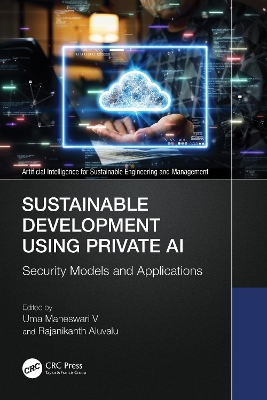
This book covers the fundamental concepts of private AI and its applications. It also covers fusion of Private AI with cutting-edge technologies like cloud computing, federated learning and computer vision.
Security Models and Applications for Sustainable Development Using Private AI reviews various encryption algorithms used for providing security in private AI. It discusses the role of training machine learning and Deep learning technologies in private AI. The book provides case studies of using private AI in various application areas such as purchasing, education, entertainment, medical diagnosis, predictive care, conversational personal assistants, wellness apps, early disease detection, and recommendation systems. The authors provide additional knowledge to handling the customers data securely and efficiently. It also provides multi-model dataset storage approaches along with the traditional approaches like anonymization of data and differential privacy mechanisms.
The target audience includes undergraduate and postgraduate students in Computer Science, Information technology, Electronics and Communication Engineering and related disciplines. This book is also a one stop reference point for professionals, security researchers, scholars, various government agencies and security practitioners, and experts working in the cybersecurity Industry specifically in the R & D division.
1. A Research Study on Concepts & Applications of Artificial
Intelligence: Governance in Smart Cities.
2. Encryption and Decryption
Algorithms in Private AI.
3. Advancing Privacy in AI: Homomorphic Encryption
and Private AI.
4. AI-Driven Privacy Preservation using Homomorphic
Encryption with AM-ResNetbased Classification in Gastrointestinal Diseases.
5. Cryptographic Security in Credit Card Fraud Detection Using Homomorphic
Encryption with CRO based Hybrid BL-GRU Classification.
6. Private AI in
Education: A Critical Challenges and Aspects of Enhancement Strategies.
7. A
model of pre-adoptive appraisal toward private AI implementation in Public
Sector Accounting Education in Higher Education Institutions.
8. Recruitment
and Staffing in educational sectors via Explainable AI and Blockchain.
9.
Private AI in Healthcare: Technological Constraints, Future Directions and
Emerging Trends.
10. Unlocking the Potential of Deep Learning in Knee Bone
Cancer Diagnosis UsingMSCSA-Net Segmentation and MLGC-LTNet Classification.
11. Enhancing Image Forgery Detection on Social Media via Grabcut
Segmentation and RA based MobileNet with MREA for Data Security.
12. Private
AI in E-Commerce: Safeguarding Consumer Data in the Digital Marketplace.
13.
Private Artificial Intelligence (AI) in Social Media.
14. Blockchain based
PrivateAI Model with RPOA based Sampling Method for Credit Card Fraud
Detection.
15. Breast Cancer Detection using Mother Optimization Algorithm
based Chaotic Map with Private AI Model
Uma Maheswari V is Senior Member of IEEE and working as an Associate Professor, Department of CSE, Chaitanya Bharathi Institute of Technology, Hyderabad, India.
Rajanikanth Aluvalu is a Senior Member of IEEE and working as Director and Professor, Symbiosis Institute of Technology, Hyderabad Campus, Hyderabad, Symbiosis International (Deemed University), Pune, India. Post Doctoral Research Fellow, COPE labs, Lusófona University, Portugal, Member, Artificial Intelligence Group, Department of Computer Engineering, Lusófona University, Portugal.