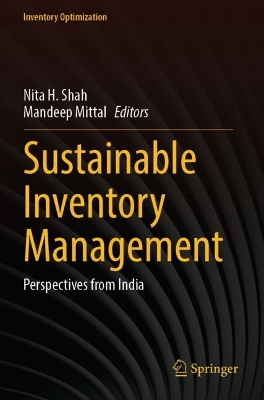
The book provides various research methods and ordering policies for inventory management in the sustainable environment in India. Sustainable inventory management is an area in which more studies from India are needed. In the age where global warming, environmental disasters, and increased public awareness about environmental issues encourage countries to reduce greenhouse gas (GHG) emissions, this book includes a collection of research studies that elaborate various inventory models to determine optimal ordering policy and provide helpful suggestions for reduction in carbon emission while managing inventory. The book is beneficial for practitioners, educators, and researchers in India and other countries. It is also helpful for retailers/managers to improve business functions and make more accurate and realistic decisions.
Chapter 1 - Sustainable inventory system with lean manufacturing and
variable demand.
Chapter 2 - A Novel Inventory Model of Growing Items & its
Waste Management.
Chapter 3 - Imperfect Production Inventory under
Multi-Production Cycle for Non-Deteriorating Items with Carbon Tax and Green
Investment.
Chapter 4 - Optimum Sustainable Inventory Model with
Preservation Technology, Promotional Efforts, and Green Technology under
Controllable Carbon Emissions in an Uncertain Environment.
Chapter 5 -
Effect of Carbon Emission and Sustainable Energy on Supply Chain with
Imperfect Quality Items under Trade Credit Policy.
Chapter 6 - Sustainable
Multistage Production Inventory Model under Joint Effect Of Preservation and
Green Technology.
Chapter 7 - Effect of Inflation on EOQ Model with
Multivariate Demand and Partial Backlogging and Carbon Tax Policy.
Chapter 8
- An InventoryModel with Both Stock-Dependent Demand Rate and Stock-Dependent
Holding Cost Rate under Uncertainty.
Chapter 9 - An Integrated Inventory
System with Decay Process Monitored Through Investment in Preservation
Technique and Demand Dependent on Displayed Stock.
Chapter 10 - An Inventory
Model for Perishables with Fixed Storage Life and Diminishing Ability to Buy
in their Life Expectancy.
Chapter 11 - Fuzzy MCDM Mathematical Modelling for
Evaluation and Selection of a Sustainable Supplier.
Chapter 12 - Emission
Considerations in an Imperfect Integrated Vendor Buyer Production Inventory
Model with Process Quality Control.
Chapter 13 - Leakage Inventory Models in
Fuzzy Environment.
Chapter 14 - Advertisement and Stock Sensitive Demand
Inventory Model for Deteriorating Items with Prepayment Scheme under
Permitted Shortage and Backordering Rate.
Chapter 15 - A Fuzzy Inventory
Problem Based on Management For Deteriorating Item With Remanufacture
Process.
Chapter 16 - Inventory Model for Imperfect Quality of Deteriorating
Items with Trapezoidal type Demand Rate under Two Storage Problem with
Learning Effect.
Chapter 17 - Optimization of Sustainable Integrated
Inventory Model for Decaying Items with Multi-Variate Demand and Controllable
Emission.
Chapter 18 - Pricing and replenishment planning for
non-instantaneous deteriorating products with preservation technology and
greening investment.
Chapter 19 - A Decision-Making Perspective for Optimal
Supplier Selection in Fermatean Fuzzy Environment.
Chapter 20 - Inventory
Management for Deteriorating Items.
Chapter 21 - Effect of carbon emission
and sustainable energy on supply chain with imperfect quality items under
trade credit policy.
Chapter 22 - Optimal Policy for Production Inventory
for Defective Items Produced by Machine Break Down with Partial Backlogging
and Controlled Carbon Emission.
Chapter 23 - An inventory model for
imperfect quality items with effect of preservational technology investments
and promotional efforts when quantity discount is offered.
Chapter 24 -
Effects of human errors and carbon emission on a stochastic supply chain
model under trade credit.
Chapter 25 - Effect of Inflation on a Sustainable
Inventory Model with Imperfect Products and Green Technology under Fuzzy
Environment.
Chapter 26 - Sustainable Inventory Model under Green
Environment with Renewable energy.
Chapter 27 - Effect of Green Sensitive
Demand on Production Inventory Model With Reliability and Partial Trade
Credit Policy.
Prof. Nita H. Shah received her PhD in Statistics from Gujarat University in 1994. Prof. Nita is HoD of Department of Mathematics in Gujarat University, India. She is post-doctoral visiting research fellow of University of New Brunswick, Canada. Prof. Nita's research interests include inventory modeling in supply chain, robotic modeling, Mathematical modeling of infectious diseases, image processing, Dynamical systems and its applications etc. She has completed 3-UGC sponsored projects. She has published 13 monograph, 5 textbooks, and 475+ peer-reviewed research papers. Five edited books are prepared for IGI-Global and Springer. Her papers are published in high impact journals. By the Google scholar, the total number of citations is over 3268 and the maximum number of citations for a single paper is over 174. The H-index is 25 and i-10 index is 83 up to February 2021. She has guided 28 Ph. D. Students and 15 M.Phil. Students till now. Eight students are pursuing research for their Ph. D. degree and one post-doctoral fellow of D. S. Kothari-UGC. She has travelled in USA, Singapore, Canada, South Africa, Malaysia, and Indonesia for giving talks. She is Vice-President of Operational Research Society of India. She is council member of Indian Mathematical Society.
Mandeep Mittal is Head and Associate Professor in the Department of Mathematics, Amity Institute of Applied Sciences, Amity University, Noida. He also served as Dean of Students Activities at Amity School of Engineering and Technology, Delhi, for nine years, and worked as Head, Department of Mathematics in the same institute for one year. He earned his post-doctorate from Hanyang University, South Korea, 2016, Ph.D. (2012) from the University of Delhi, India, and post-graduation in Applied Mathematics from IIT Roorkee, India (2000). He has published more than 70 research papers in international journals and international conferences. He has edited five research books with international publishers like Springer, and is a series editor of Springer series Inventory Optimization. He is a member of editorial boards of Revista Investigacion Operacional, Journal of Control and Systems Engineering, and Journal of Advances in Management Sciences and Information Systems.