Muutke küpsiste eelistusi

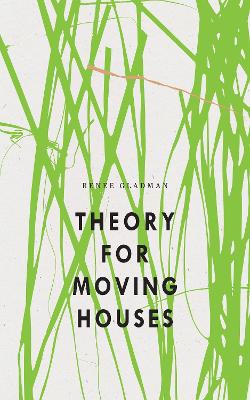
Theory for Moving Houses [Pehme köide]

  • Formaat: Paperback / softback, 104 pages, kõrgus x laius: 209x152 mm, Abstract paintings: guache, pen & ink
  • Ilmumisaeg: 18-Jun-2026
  • Kirjastus: Wave Books
  • ISBN-13: 9798891060425
Teised raamatud teemal:
  • Pehme köide
  • Hind: 28,64 €
  • See raamat ei ole veel ilmunud. Raamatu kohalejõudmiseks kulub orienteeruvalt 3-4 nädalat peale raamatu väljaandmist.
  • Kogus:
  • Lisa ostukorvi
  • Tasuta tarne
  • Tellimisaeg 2-4 nädalat
  • Lisa soovinimekirja
  • Formaat: Paperback / softback, 104 pages, kõrgus x laius: 209x152 mm, Abstract paintings: guache, pen & ink
  • Ilmumisaeg: 18-Jun-2026
  • Kirjastus: Wave Books
  • ISBN-13: 9798891060425
Teised raamatud teemal:
"You are asking me where I live and it's making me think all these things about space, where I start and end in space and where space starts and ends in me and when, in space, I am a body and when I'm a book, in space. So begins Renee Gladman's Theory for Moving Houses, and with these lines we are invited into a liminal space of imagination and investigation, as Gladman guides us through the architectures of her poetics. Foundational here is a sense of fluidity, a slippage of time, a devotion to "non-linear and hyper gestural movement," a communal spirit. Gladman's inquiry into her intersecting practices of writing and drawing reveals a deep commitment to uncertainty and "fictional knowing." Yet again, Gladman upends traditional expectations of prose, asshe leads us through landscape of her Ravicka series novels, ultimately surprising us with a novel within nonfiction. The latest volume in Wave's Bagley Wright Lecture Series, Theory for Moving Houses is not only visionary it its contemplations but also is a virtuosic example of the ways in which language can shape utopian sites of possibility"-- Provided by publisher.

You are asking me where I live and it’s making me think all these things about space,where I start and end in space and where space starts and ends in me and when, inspace, I am a body and when I’m a book, in space.

So begins Renee Gladman's Theory for Moving Houses, and with these lines we are invited into a liminal space of imagination and investigation, as Gladman guides us through the architectures of her poetics. Foundational here is a sense of fluidity, a slippage of time, a devotion to “non-linear and hyper gestural movement,” a communal spirit. Her inquiry into her intersecting practices of writing and drawing reveals a deep commitment to uncertainty and “fictional knowing.” Yet again, Gladman upends traditional expectations of prose, as she leads us through landscape of her Ravicka series novels, ultimately surprising us with a novel within nonfiction. The latest volume in Wave’s Bagley Wright Lecture Series, Theory for Moving Houses is not only visionary it its contemplations but also is a virtuosic example of the ways in which language can shape utopian sites of possibility.

Arvustused

Renee Gladman has always struck me as being a dreamershe writes that way and the dreaming seems to construct the architecture of the world unfolding before our reading eyes.Eileen Myles Gladmans talent for linguistic architecture makes for a supple, tight promenade through heady ideas whose appeal rests on the implicit connection it draws between a people, their language, and the shape of communication.Publishers Weekly


This attention to the movement and moment of the line distinguishes her work from those other experiments with drawn poems, such as Robert Greniers drawing poems or Cy Twomblys calligraphic paintings, that we might reach to for comparison....Its as if shes discovered the place where the living line and the line of language converge after a temporary separation.Mary Wilson, Jacket2

Renee Gladman is a writer and artist preoccupied with crossings, thresholds, and geographies as they play out at the intersections of poetry, prose, drawing and architecture. She is the author of fourteen published works, including a cycle of novels about the city-state Ravicka and its inhabitants, the RavickiansEvent Factory(2010),The Ravickians(2011),Ana Patova Crosses a Bridge(2013) and Houses of Ravicka(2017)as well as three collections of drawings:Prose Architectures(2017),One Long Black Sentence, a series of white ink drawings on black paper, indexed by Fred Moten (2020), and Plans for Sentences(2022). Recent essays and visual work have appeared POETRY Magazine,The Paris Review,Gulf Coast,Granta,Harper's,BOMB magazine, e-flux and n+1. She has been awarded fellowships, artist grants, and residencies from the Radcliffe Institute for Advanced Study at Harvard, Foundation for Contemporary Arts, the Lannan Foundation, and KW Institute for Contemporary Art (Berlin), and is a 2021 Windham-Campbell Prize winner in fiction. She makes her home in New England with poet-ceremonialist Danielle Vogel.