Muutke küpsiste eelistusi

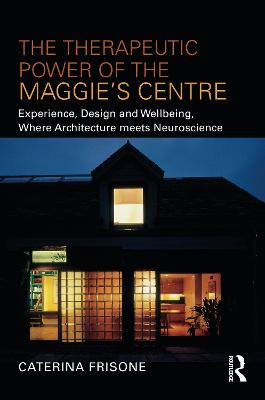
Therapeutic Power of the Maggies Centre: Experience, Design and Wellbeing, Where Architecture meets Neuroscience [Kõva köide]

(Oxford Brookes University, UK)
  • Formaat: Hardback, 234 pages, kõrgus x laius: 234x156 mm, kaal: 680 g, 4 Tables, black and white; 6 Line drawings, black and white; 52 Halftones, black and white; 58 Illustrations, black and white
  • Ilmumisaeg: 07-May-2024
  • Kirjastus: Routledge
  • ISBN-10: 1032154578
  • ISBN-13: 9781032154572
  • Kõva köide
  • Hind: 149,06 €*
  • * hind on lõplik, st. muud allahindlused enam ei rakendu
  • Tavahind: 198,75 €
  • Säästad 25%
  • Raamatu kohalejõudmiseks kirjastusest kulub orienteeruvalt 3-4 nädalat
  • Kogus:
  • Lisa ostukorvi
  • Tasuta tarne
  • Tellimisaeg 2-4 nädalat
  • Lisa soovinimekirja
  • Raamatukogudele
  • Formaat: Hardback, 234 pages, kõrgus x laius: 234x156 mm, kaal: 680 g, 4 Tables, black and white; 6 Line drawings, black and white; 52 Halftones, black and white; 58 Illustrations, black and white
  • Ilmumisaeg: 07-May-2024
  • Kirjastus: Routledge
  • ISBN-10: 1032154578
  • ISBN-13: 9781032154572

This book is about the therapeutic environment of the Maggie’s centre and explores the many ways this is achieved. With an unconventional architecture as required by the design brief, combined with Maggie’s psychological support programme, this special health facility allows extraordinary therapeutic effects in people, to the point that one can speak of therapeutic power.

After tracing the story of the Maggie’s centre, the book reveals its fundamentals: Maggie’s Therapeutikos (the-mind-as-important-as-the-body), the Architectural Brief and the ‘Client-Architect-Users’ Triad. It continues by unfolding Maggie’s synergy-that between people and place-which increases users’ psychological flexibility helping them tolerate what was intolerable before. Although comfort and atmospheres are paramount, they are not enough to define the therapeutic environment of the Maggie’s centre. Only by looking at neuroscience that can give us scientific explanations of empathy, feelings and emotions and only considering space neither neutral nor empty, but full of forces that envelop people in an embodied experience, can we explain what generates wellbeing in a Maggie’s centre.

The book concludes by critically evaluating the Maggie’s centre as a model to be applied to other healthcare facilities and to architecture in general. It is essential reading for any student or professional working on therapeutic environments.


This book explores the many ways in which the therapeutic environment of the Maggie’s centre is achieved. The book critically evaluates the Maggie’s centre as a model to be applied to other healthcare facilities and to architecture in general. It is essential reading for any student or professional working on therapeutic environments.

Arvustused

"The role of emotions and feelings for a person left alone in that limbo that follows a cancer diagnosis is why Maggie Keswick Jencks started her pilot project for a centre with a human element at its core which, since 1996, has continued to grow to help more and more people with cancer. Explaining our philosophy with strength and passion, this book promotes Maggies values that hopefully go beyond healthcare and reach a wider architectural audience."

Dame Laura Lee, Maggies CEO

"And I came in and I was in the centre for about three hours, and the initial feeling of walking through that door, and just looking up and seeing it, was there even then and felt that powerful, that I was in a powerful place. I think I felt I was in a safe place. And that's what I feel when I've come into Maggies, I feel safe, here."

Malita, Maggies Dundee visitor

"I couldnt believe my cancer diagnosis, but then I thought I can come here every day! I can sit in a corner and cry some time, yeah! I swear to God, if I didnt have it, I dont think I would be ok as I am."

Elizabeth, Maggies Barts visitor

"This is not the business of healthcare, but it is the business of the spirit. And it really is a very spiritual place, in a non-religious way."

Carol, Maggies Oldham visitor

1.Introduction
2. Maggies Therapeutic Environment
3. The Maggies
centre 4.Maggies Fundamentals 5.Maggies Synergy 6.Maggies Phenomenology
7.Maggies as a Paradigm and the Future of the Architecture of Care 8.Epilogue
Caterina Frisone earned her PhD and was Associate Lecturer in Interior Architecture at Oxford Brookes University, UK. She is now the Scientific Director of the Postgraduate programme Master in Architecture and Health at the University Iuav of Venice.