Muutke küpsiste eelistusi

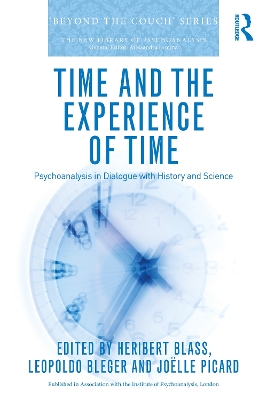
Time and the Experience of Time: Psychoanalysis in Dialogue with History and Science [Pehme köide]

Edited by , Edited by , Edited by (Training Analyst of the French Psychoanalytical Association, Paris, France)
  • Formaat: Paperback / softback, 134 pages, kõrgus x laius: 234x156 mm, kaal: 280 g, 4 Line drawings, black and white; 1 Halftones, black and white; 5 Illustrations, black and white
  • Sari: The New Library of Psychoanalysis 'Beyond the Couch' Series
  • Ilmumisaeg: 23-Dec-2025
  • Kirjastus: Routledge
  • ISBN-10: 1041114052
  • ISBN-13: 9781041114055
  • Pehme köide
  • Hind: 34,64 €*
  • * hind on lõplik, st. muud allahindlused enam ei rakendu
  • Tavahind: 46,19 €
  • Säästad 25%
  • Raamatu kohalejõudmiseks kirjastusest kulub orienteeruvalt 3-4 nädalat
  • Kogus:
  • Lisa ostukorvi
  • Tasuta tarne
  • Tellimisaeg 2-4 nädalat
  • Lisa soovinimekirja
  • Raamatukogudele
  • Formaat: Paperback / softback, 134 pages, kõrgus x laius: 234x156 mm, kaal: 280 g, 4 Line drawings, black and white; 1 Halftones, black and white; 5 Illustrations, black and white
  • Sari: The New Library of Psychoanalysis 'Beyond the Couch' Series
  • Ilmumisaeg: 23-Dec-2025
  • Kirjastus: Routledge
  • ISBN-10: 1041114052
  • ISBN-13: 9781041114055

With particular reference to neurobiology and neuroscience, this book explores a psychoanalytic understanding of time, and how ideas of time affect our experiences in clinical practice and in everyday life.


With particular reference to neurobiology and neuroscience, this book explores a psychoanalytic understanding of time and how ideas of time affect our experiences in clinical practice and in everyday life.

The contributions examine new perspectives on numerous phenomena associated with the perception of time. In addition to the physics-based discussion of whether time and a now exist at all, whether the existence of time can be proven neuroscientifically, or how historical forms of the relationship to time develop, the authors consider memory, forgetting or regression, the emergence of the past in the present, the anticipation of the future, as well as mental development and the psychoanalytical process, particularly from the aspect of presence. The book shows how psychoanalysis can escape scientific isolation and develop further in a lively, mutually enriching exchange with other sciences.

Drawing on scientific insights as well as the latest psychoanalytic thinking, this is essential reading for all psychoanalysts, psychotherapists, and anyone wanting a deeper understanding of the place of time in our lives.

Arvustused

"This book is a convincing example of how contemporary psychoanalysis is constantly continuing and revitalizing the Freudian tradition of innovative interdisciplinary dialogues. Particularly severely traumatized analysands feel thrown out of time, never really having arrived in their own life, without a sense of past, present and future. The search for lost times (A la recherche du temps perdu, Proust) in psychoanalysis becomes an existential experience for many of them. However: how can such central psychic transformations be understood from the perspective of today's neurosciences, modern physics, philosophy and history? The outstanding authors of this volume take the reader on a stimulating journey towards a deeper understanding of time as one of the basic categories of human life."

Prof. Dr. Marianne Leuzinger-Bohleber, Psychoanalytic principal investigator of the MODE Study, recipient of the IPAs Outstanding Scientific Achievement Award, 2023, Germany

"An extraordinary collection that bridges psychoanalysis, neuroscience, and other sciences, like physics and history, to illuminate the multiple experiences of time. Profoundly relevant for understanding temporality in clinical practice and theory. A major contribution to contemporary psychoanalytic thought."

Dr. Jorge Eduardo Catelli, Psy.D., Full Member and Training Analyst of the Argentine Psychoanalytic Association, Argentina

"This volume is a fine literary achievement expressing the EPF spirit of dialogic exchange which arose in the Symposium on Time (2022). The chapters illustrate a creative crosspollination of inter-disciplinary thinking that evolved. The arguments are lively, compelling and generative. This book is sure to endure the test of time and become one of the classic EPF books."

Jan Abram, EPF President (2024 2028) and author of 'The Surviving Object: Psychoanalytic clinical essays on psychic survival-of-the-object (2022)' New Library of Psychoanalysis, Routledge, UK

Preface
1. On the EPF Symposium on Time April 9-10, 2022, and on the
present book
2. Science, Psychoanalysis and the Time of the Session
3.
Neurobiology of Time
4. Discussion of Arnaldo Beninis paper: Neurobiology of
Time
5. What is Time? Thoughts of a Physicist
6. Discussion of Gernot
Münster´s paper: What is Time? Thoughts of a Physicist
7. Encounters with
Chronos
8. Discussion of François Hartog´s paper: Encounters with Chronos
9.
Kairos and Chronos. Clinical-psychoanalytical reflections on time
10.
Discussion of Bernd Nissen´s paper: Kairos and Chronos.
Clinical-psychoanalytical reflections on time
11. The complexity of the
dialogue between neurosciences and psychoanalysis. EPF-Symposium Berlin 2015:
'Psychoanalysis in 2025
12. Afterthoughts
Heribert Blass, Dr. med. (MD), is Training and Supervising Analyst for Adults, Children, and Adolescents; Specialist in Psychosomatic Medicine and Psychotherapy, Psychiatry, in Dusseldorf, Germany.

Leopoldo Bleger, Dr. med. (MD), is Supervisor Analyst of the French Association of Psychoanalysis (AFP), France.

Joëlle Picard, Dr. med. (MD), is Psychiatrist and Training Analyst (Supervisor) in Paris, France.