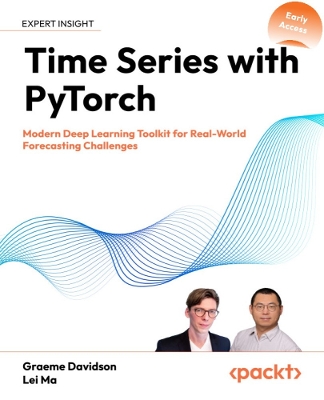
Leverage time series analysis for better decision making with cutting-edge tools and techniques
Key Features
Get to grips with concepts through jargon-busting explanations Learn to use a variety of datasets that reflect problems youre likely to encounter in everyday practice Understand how to select the appropriate algorithms to avoid unnecessary complexity Learn from progressive and pedagogical chapters that guides you from introductory toy problems to end-to-end real-world projects
Book DescriptionDeep learning (DL) is a cutting-edge approach to learning from data. While it has taken the areas of computer vision and natural language processing by storm, its application to time-series forecasting is a more recent phenomenon and remains challenging for both new and experienced practitioners. To develop the best time series models for a real-world problem, it is essential to have not only a thorough understanding of the time series data but also a solid grasp of DL models themselves. This book investigates time series structures and the DL approaches that can address the variety of challenges they present to practitioners in industry. In this book, you will gain insights from a variety of perspectives, both from the data and the models. You will learn about the complexities of real-world time series data, explore the different problem settings for time series analysis, touch upon the foundation of DL models for time series, and practice end-to-end time series analysis projects when DL works; the authors believe in choosing the best tool for the problem, so traditional methods are never far from our minds. A GitHub repository with coding examples will be provided to support your journey. By the end of this book, you will be able to approach almost any time series challenge with an appropriate model that gets you results.What you will learn
Develop an understanding of how to code and test neural networks with PyTorch and PyTorch Lightning Address challenges presented by different data structures with neural architecture Learn advanced methods to evaluate and validate models by comparing and optimizing them and partitioning your data correctly Gain insight into how time series models work behind the scenes and why a model fits a particular type of problem Apply contemporary approaches like TFT, NBEATs, and NHiTS for individual forecasts and hierarchical modeling
Who this book is forThis book is for data analysts, scientists, and students who want to know how to apply deep learning methods to time-series forecasting problems with PyTorch for real-world business problems. While the book assumes some understanding of statistics and modeling, you wont need in-depth knowledge of time-series to follow along. Some awareness of Python programming is important, but we do not assume any prior knowledge of PyTorch. The main goal of this book is to be accessible for those with little or no experience with deep learning methods in time series.