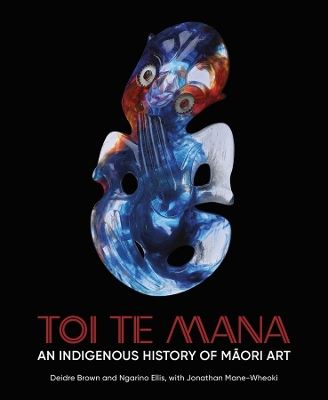
"The achievement of Toi Te Mana (which roughly translates as arts of power) is of another order altogether. Its subtitle points to its distinctiveness. This is both a work grounded in and animated by Mori conceptsof time, place, people and valuablesand the outcome of sophisticated art-historical research, which deftly mobilizes the disciplines foundational methods and the feminist and postcolonial perspectives that have challenged the field. . . . Toi Te Mana is remarkable not only for its lucid broader history but also for fascinating detail regarding specific works, images, and histories, and even of quirks such as notable fakes." * Apollo, on the selection of Toi Te Mana as their 2025 Book of the Year * "Here, the breadth of Mori artistic practices, from shipbuilding to urban graffiti, is placed within a continuum of Mori heritage. A traditional cloak can embody a tribes whakapapaits inheritances and genealogieswithin the pattern of the weave and the materials used. Large, gorgeous images capture centuries-old objects, abstract modern installations, and everything in between, tying visual detail to cultural significance with textual analysis. This is a passionate work of scholarship that will capture the minds of students and practitioners of Indigenous art." * Foreword Reviews (starred review) * "A new landmark book celebrating Mori art has clocked up a couple of impressive firsts: not only is it the most comprehensive account of creative work by Indigenous New Zealanders ever published, it is also the first wide-ranging art history written entirely by Mori scholars. . . . The book traverses Mori creativity across time and locations from ancient ocean-voyaging waka (canoe) to intricately carved treasure boxes held in international museums, painting and street art, digital film, protest flags and a Venice Biennale award-winning installation. The book also highlights forgotten artists and overlooked mediums such as Mori architecture." * The Guardian * "This groundbreaking survey has been a decade in the making and is informed by the belief of the authors that 'a greater understanding of Mori artby Mori and non-Moriis essential for the survival of Mori culture.'" * Apollo "Off the Shelf" column * "This volume covers 800 years of Mori art, exploring a range of art practices including raranga (plaiting), whatu (weaving), moko (tattooing), and whakairo (carving). The volume, written by a trio of Mori art historians, took 12 years to complete and focuses on 'exploring the idea of Indigenous art histories that value Indigenous voices, perspective and objectives, making art history more relevant and less Eurocentric,' the authors say." * The Art Newspaper "Book Bag" column * Toi Te Mana demonstrates what becomes possible when Indigenous epistemologies structure the telling of art (hi)stories. The book is not only a major contribution to Mori art historyit is also a theoretical intervention with wide-reaching implications for Indigenous studies, museum practice, anthropology, and visual culture. My awaiting this volume with great curiosity and enthusiasm was entirely justified; what Toi Te Mori delivers is monumental. It is aesthetically sumptuous, intellectually rigorous, and methodologically innovative. By grounding its narrative in the three baskets of knowledge, it honors Mori ways of knowing while offering readers a coherent and generous guide through centuries of artistic practice. For scholars, artists, curators, students, and all those engaged with Indigenous arts or the rethinking of art history, this book is an essential reading. It is a landmark publication that will continue to shape the field for generations to come. -- Fanny Wonu Veys * Pacific Arts * "Extremely beautiful. . . . A benchmark book that documents stories of resilience and endurance. . . . This book demonstrates that Mori art is about excellence." * Radio New Zealand, on three of the best books of 2024 * "Groundbreaking, monumental in scale, this is the most comprehensive survey of mahi toi ever created, from carving to textiles and digital art, written by experts in the field." * The Listener (New Zealand), on the 100 best books of 2024 * "Very soon this book will become a taonga in its own right." -- Hamish Coney * Newsroom * "Toi Te Mana is a massive tome and an even greater achievement." -- Don Abbott * Art New Zealand * "What a beautiful monster of a book. Not solely through its massive weight and plenitude of pages, but more significantlyindeed far more significantlybecause of its inherent kaupapa." -- Vaughan Rapatahana * Flaxroots * "A 600-page new book that took 12 years to create is set to reframe the history of Mori art. . . . Toi Te Mana is a whopper of a book, but its also beautiful and very readable. . . . In many cases the research is only just starting, with Toi Te Mana representing an important beginning to a new Aotearoa art history." * Radio New Zealand Culture 101 * "The recently published history of Mori art Toi Te Mana by Deidre Brown and Ngarino Ellis with Jonathon Mane-Wheoki, is a magnificent volume with intense scholarship and beautiful presentation 'written by, for, and about Mori'." * New Zealand Herald * "'One has to look back to look forward,' expert weaver Diggeress Te Kanawa once remarked. The massive new book Toi Te Mana does exactly this, exploring the deep history of Mori art, from its ancestral origins through to its contemporary expression, to provide context and inspiration for todays Indigenous artists. . . . This book is by no means small, but it is certainly significant. A joy to read, and a valuable resource" * E-Tangata (New Zealand) * Toi te Mana is a bold and ambitious endeavour by our most experienced Mori art historians responding to a desperate need in New Zealand art education. A historical atlas encompassing the spectrum of Mori creativity, this work will certainly become a standard text of Mori art history and contribute to the global discourse on indigenous art histories in which Mori already hold a strong and distinctive position. -- Anna-Marie White (Te Atiawa), Toi Maori Aotearoa: Maori Arts New Zealand This book is a comprehensive analysis that sets out to recalibrate the history of Mori art by rebalancing the gaps and Eurocentric focus of earlier writing. The format, with key chapters (kete) interspersed with breakout boxes focusing on specific artists and events, drives the kaupapa of the book forward, reinforcing a broadly chronological framework that nevertheless emphasises non-linearity, dynamism and change. The deployment of ancestral stories, chants and whakatauk to introduce chapters and sections draws together multiple strands to create a richly layered and relational landscape (whakapapa) for Mori arts. Ka mau te wehi! An outstanding contribution to Mori culture, arts and creativity it is a great read. -- Maia Nuku (Ngai Tai), curator of Oceanic art, Metropolitan Museum of Art, New York Toi Te Mana is a historic and groundbreaking text. It is an invaluable tool for Indigenous arts globally and represents best practice in the field. The research and findings will be central to those of my generation and our students as we craft an Indigenous art history. -- Nancy Mithlo, University of California, Los Angeles This book provides an Indigenous account of Mori art, authored by Mori art historians, employing art historical methods, while highlighting its status as one of the foremost global art traditions. The authors hold considerable esteem in our field, which is reflected in the originality and irrefutable high level of scholarship of their work. They have integrated ancestral history and worldwide collections into a unified and meticulously researched and referenced book. The work is admirable in every respect. -- Jennifer J. Wagelie, director of cultural development and equity initiatives, California State University, Sacramento "Toi Te Mana is a cultural feat ruminating on the luxurious depth and breadth of Mori art. From waka to painting to bodies, Brown, Ellis and Mane-Wheoki expertly fill each kete with insights, histories and analysis. This is a one-in-a-generation book." -- Lana Lopesi, University of Oregon "Toi Te Mana is an outstanding publication that brings to fruition the work of two exceptional Mori scholars and their visionary collaborator, the late Mori art historian Jonathan Mane-Wheoki. The book is not only a landmark in Mori art history, it challenges us to reconceive the entire narrative of art and modernity from the perspective of Indigenous cultures worldwide." -- Peter Brunt, Te Herenga Waka Victoria University of Wellington "A big, beautiful book full of fresh ideas. Reading the text is like hearing the taonga speak." * The Post (New Zealand) *