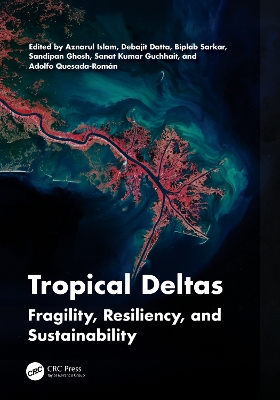
Tropical deltas of the world are in decline and are threatened by climate change, geo-environmental dynamics, natural hazards, and disasters. This book is a comprehensive discussion of the present delta crisis and the various risks the deltas are facing due to human and natural factors. It addresses their resilience, the importance of biodiversity, and the future adaptations for sustainable management of tropical deltas. The use of geospatial tools for the assessment and modeling of environmental degradations and the applications of artificial intelligence (AI) and machine learning (ML) are examined in 22 chapters, from different major deltas of the world, to help readers understand the interdisciplinary perspective of deltas’ vulnerability and sustainability.
Features
- Provides comprehensive coverage of global tropical deltas, their physical environments, hazard profiles, and socio-economic threats in a changing climate.
- Includes research-based discussions blended with global case studies to demonstrate the status of deltas around the world and the status of field-based investigations.
- Offers a holistic understanding of multifaceted dimensions of delta crises due to changes in landscape ecology, and the impact of various natural and man-made hazards.
- Addresses the critical challenges of sustainable management using a modeling approach with spatial maps and geostatistical diagrams.
- Discusses perspectives of restoring delta systems around the globe for solving environmental and societal problems.
This reference book is for researchers, academics, graduate and senior undergraduate students in geography, geomorphology, hydrology, regional planning, environmental science, ecology, and engineering, and those interested in water conservation and sustainability, including professionals in industry and government, and human rights activists.
Tropical Deltas: Fragility, Resiliency, and Sustainability is a comprehensive discussion of the present delta crisis and the risks the deltas are facing due to human and natural factors. It addresses their resilience, the importance of biodiversity, and future adaptations for sustainable management of tropical deltas.
1. Delta Sustainability in the Context of Fragility and Resilience. Part
I: Land and Geomorphological Issues.
2. A Systematic Review of
Geomorphological Crises in Deltas Across the World.
3. Sustainable Coastal
Zone Management Through Sediment Characterization: End-Member Modeling of
Erosion-Accretion Processes for Enhanced Resilience in Eastern Coastal Zone,
India.
4. Quantifying the Soil Erosion in the Changing Climate: A Case Study
of the Indian Tropical Delta.
5. Hydromorphology and Geodiversity of Select
Estuaries along the Eastern Coastline of India.
6. Mid-Channel Bar Dynamics
of Bhagirathi-Hooghly River.
7. Latin American and Caribbean River Deltas:
Physical Geography and Environmental Challenges. Part II: Climate Change and
Hydrological Issues.
8. Storm Surge Induced Seawater Intrusion: A
Comprehensive Systematic Review.
9. Addressing Water Stress in Tropical Delta
in Tropical Deltas in the Era of Climate Change with Special Reference to
Sundarbans.
10. An Enquiry into the Groundwater Landscape in Deltaic Tract
and its Fringe Areas Within West Bengal: Present Scenario and Future
Direction.
11. Unravelling the Vulnerability and Fragility of the Sundarbans
(West Bengal, India): Impacts of Changing Climate, Sea Level Rise and
Salinity on the Coastal Mangrove Ecosystem. Part III: Environmental and
Ecological Issues.
12. Threats and Risks in Tropical and Subtropical Deltaic
Ecosystems: Implications for Sustainability.
13. A Comprehensive Analysis of
Eutrophication and Its Ecological Consequences in the Ganga-Brahmaputra Delta
(GBD).
14. Assessment of Landscape Ecological Sensitivity in the Lower
Subarnarekha Delta Plain: A Three Decadal Spatio-temporal Perspective.
15.
Human-induced Challenges of Riverine Morphology and Ecology in the
South-western Deltaic Region of Bangladesh.
16. Monitoring the Dynamics of
Coastal Vegetation of Sindhudurg District, Maharashtra (India): A Geo-Spatial
Approach.
17. Wouri River Estuary and Coastal Mangrove Forests near Douala
Coastal Diversity Under Threat. Part IV: Societal Crisis Management.
18.
Unravelling Social and Political Ecologies of Coastal Brackish Water
Aquaculture in the Medinipur Coastal Plain, India.
19. The Fading Homeland:
Belonging and Displacement in a Crisis-Torn Indian Sundarbans.
20. Predictive
Modeling of Aman Rice Yields during Monsoon Extremes Integrating Multi-Sensor
Datasets and Machine Learning Techniques.
21. Resilience at the Edge:
Community-Centric Coping Approaches and their Role in Shaping Vulnerability
in the Indian Sundarban.
22. Collaborative Initiatives for Restoring Delta
Habitats: Integrating Scientific Research and Community Participation.
Aznarul Islam is an Assistant Professor in the Department of Geography, at Aliah University, Kolkata, India. His principal areas of research include floods, channel shifting, riverbank erosion, river pollution, and water resource management. He has published more than 65 research papers in different journals and has authored one book and edited 10 books along with 26 book chapters in edited volumes and conference proceedings. He has presented papers in more than 25 national and international seminars and conferences.
Debajit Datta is an Assistant Professor of Geography at the Jadavpur University, Kolkata, India. He specializes in landscape ecology and environmental planning. He has extensively worked on the management of coastal and forest ecosystems of eastern India, potentials of ecotourism development and sustainable livelihood generation of indigenous communities for the last 16 years. He has published more than 60 research papers and scientific articles in peer-reviewed journals, edited book volumes, and periodicals.
Biplab Sarkar is a Researcher in Geography at Aliah University, Kolkata, India. He is investigating the ecomorphological responses to climate change and human interventions in the Bengal Delta. He has published four research articles in different journals and three book chapters.
Sandipan Ghosh is an Assistant Professor in the Department of Geography, Chandrapur College, West Bengal, India. His principal research field includes Fluvial Geomorphology, Regolith Geology and Quaternary Geomorphology. He has published four books and over 40 research articles in various geography and geosciences journals.
Sanat Kumar Guchhait is a Professor in the Department of Geography, at the University of Burdwan, West Bengal, India. His areas of research and publication are about the tune of the environment, society, and livelihood. He has successfully supervised 11 doctoral students and published 65 research papers in different peer-reviewed journals and edited books.
Adolfo Quesada-Romįn has been working with local and national governments, international NGOs, private companies, research institutes, and universities worldwide, focusing on disaster risk management, cartography and geospatial analysis, environmental impact studies, and natural resource management. He has published over 100 indexed publications in these fields.