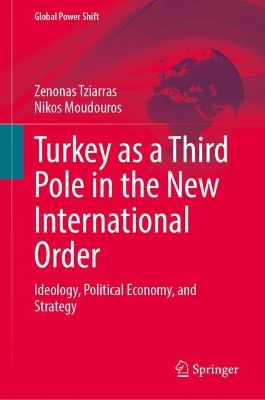
This book offers a fresh and rigorous interpretation of Turkeys international orientation and evolving role in global politics, arguing that Ankara is positioning itself as a Third Pole within a rapidly transforming international system. Moving beyond the traditional WestEast dichotomy, it demonstrates how contemporary Turkeyshaped by profound ideological, political-economic, and strategic shifts under the AKPpursues an autonomous and assertive foreign policy that often challenges the liberal, West-centric order.
Grounded in a Neoclassical Realist framework, the authors explore why Turkey is frequently conceptualized as an exceptional state and what this exceptionality reveals about its foreign policy behaviour. It shows how geography, identity, and shifting global alignments have produced a foreign policy that can be at once cooperative, competitive, and revisionist. The analysis traces the interplay of ideological currentsfrom Kemalism to Islamism and Eurasianismculminating in a synthesis of Islamic Eurasianism that increasingly shapes Turkeys strategic outlook.
Central to the argument is the suggestion that conventional categories such as middle power, swing state, or pivotal state fail to capture Turkeys ambitions and foreign policy behaviour. The original concept of the Third Pole is introduced to address this gap, offering a nuanced, country-specific lens to explain Turkeys aspirations, policy choices, and structural constraints. The concept is tested through four critical case studiesthe Syrian conflict, the war in Ukraine, the Greek-Turkish dispute, and the 2023 Gaza Warillustrating how Turkey both influences and adapts to the dynamics of a transitioning international order. The result is a timely account of how Turkey navigates an unstable global landscape while seeking strategic autonomy, regional influence, and a reimagined civilizational and global role.