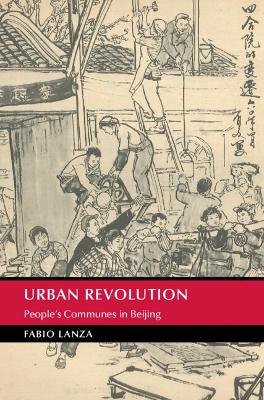
'Sometimes state sources reveal much more than what the state wants us to know. This absorbing account of China's short-lived urban communes pulsates with the enthusiasm, ingenuity, frustration, and yearning of Beijing residents. Central to Lanza's story are housewives, who were crucial to a development strategy that incessantly undervalued and shortchanged them.' Gail Hershatter, University of California, Santa Cruz 'A unique intervention by a major scholar, this book challenges us to think seriously about the possibilities and impossibilities of socialism in China's mid-twentieth century. With a focus on the urban commune movement in Beijing (1958-1963), Lanza reveals in meticulous detail how everyday life in China's capital was made and unmade by radical experimentations on extant social structures.' Rebecca E. Karl, New York University 'In this brilliantly conceived and deeply researched study, Fabio Lanza uncovers a long-overlooked urban front of the Maoist revolution. Urban Revolutions transforms our understanding of the Great Leap Forward, revealing how radical experiments in Beijing's neighborhoods reshaped everyday life, labor, family, and urban space. Offering a powerful new perspective on revolution, ideology, and the making of socialist modernity, it stands as a landmark contribution to both modern China studies and the global history of urbanism.' Yiching Wu, University of Toronto