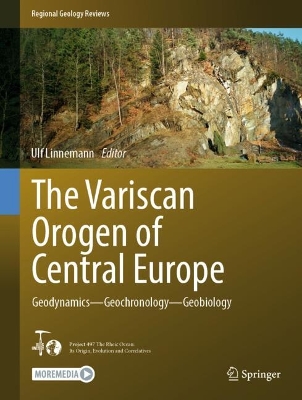
The book is written by international team of specialized geoscentists and represents the current knowledge of the evolution of the Variscan Orogen in Central Europe. After a preface, the geotectonic position of the mountain belt within the supercontinent Pangea and the zoning of the orogen is described (Chapter 1). The birth of the Central European Variscides and the role of the Avalonian and Cadomian orogenic processes as forerunners of the Central European Variscides is presented also in Chapter 1. The big building blocks of the Variscan orogen north and south of the Rheic suture are lined out in detail in the main part of the book (Chapters 2 to 18). After the description of the igneous activity in Permo-Carboniferous time (Chapter 19), neotectonic reactivation (Chapter 20), current models for Variscan orogenic processes (Chapter 21) and the zircon data base (Chapter 22) are briefly characterized. A final major section (Chapters 23 to 29) includes geobiological, palaeontological and palaeoenvironmental data including event stratigraphy relevant for Variscan plate tectonics. The book is written for an international readership of professional geoscientists, of students of natural sciences, and of people interested in the formation and geology of Central Europe.
1. Inside Pangaea: The Variscan Orogen and its zoning.- 2. The birth of
the Variscan Orogen: The interaction of Baltica, Avalonia, Northwest Africa,
and Cadomia.- 3. Building blocks north of the Variscan Suture.- 4. Building
Blocks south of the Variscan Suture.- 5. Permian-Carboniferous magmatism.-
6. Variscan orogenic processes.
Ulf Linnemann is Head of Department of the Museum of Mineralogy and Geology of the Senckenberg Naturhistorische Sammlungen Dresden (SNSD), where he has been since 1996, and Full University Professor of Geology at the Technical University of Dresden (TUD). He is founder and leader of the Geochronology Section (GeoPlasmaLab) at SNSD. Linnemann obtained his first degree from the Institute of Geology at the Technical University Bergakademie Freiberg in 1986, and his Ph.D. from the same institution in 1990. As a research fellow he worked at the Institute of Soil and Site (Tharandt, TUD, 1990-93) and at the Institute of Geosciences (Friedrich-Schiller University, 1993-96). He earned his Habilitation in 2008 at TUD. In 2009 Ulf Linnemann managed the transfer of the Museum of Mineralogy and Geology Dresden into the Senckenberg Society of Natural Research and the establishment of the institution as a member of the Leibniz Association. Ulf Linnemann was leader of the IGCP 497 The Rheic Ocean: Origin, Evolution, and Significance (2004-2009). His main research interests are provenance analysis, especially through UPb-dating and Hf-Isotope signatures of detrital and magmatic zircon, and the application of basin analysis and plate tectonics to orogenic processes, especially in the AvalonianCadomian belts of northern Gondwana and their incorporation into the Alleghanian-Variscan orogen. His work outside Europe is focused on the Precambrian and Lower Palaeozoic rocks of Namibia, Morocco, Mauretania, and other regions in Africa.