Muutke küpsiste eelistusi

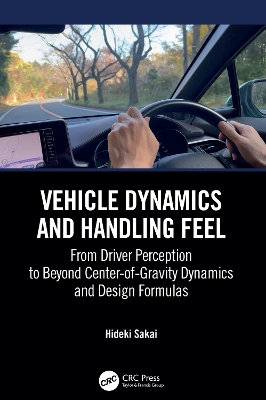
Vehicle Dynamics and Handling Feel: From Driver Perception to Beyond Center-of-Gravity Dynamics and Design Formulas [Kõva köide]

  • Formaat: Hardback, 344 pages, kõrgus x laius: 234x156 mm, 38 Tables, black and white; 168 Line drawings, black and white; 7 Halftones, black and white; 175 Illustrations, black and white
  • Ilmumisaeg: 23-Jun-2026
  • Kirjastus: CRC Press
  • ISBN-10: 1032427698
  • ISBN-13: 9781032427690
Teised raamatud teemal:
  • Kõva köide
  • Hind: 123,75 €*
  • * hind on lõplik, st. muud allahindlused enam ei rakendu
  • Tavahind: 165,00 €
  • Säästad 25%
  • See raamat ei ole veel ilmunud. Raamatu kohalejõudmiseks kulub orienteeruvalt 3-4 nädalat peale raamatu väljaandmist.
  • Kogus:
  • Lisa ostukorvi
  • Tasuta tarne
  • Tellimisaeg 2-4 nädalat
  • Lisa soovinimekirja
  • Formaat: Hardback, 344 pages, kõrgus x laius: 234x156 mm, 38 Tables, black and white; 168 Line drawings, black and white; 7 Halftones, black and white; 175 Illustrations, black and white
  • Ilmumisaeg: 23-Jun-2026
  • Kirjastus: CRC Press
  • ISBN-10: 1032427698
  • ISBN-13: 9781032427690
Teised raamatud teemal:
In this book, Sakai provides a comprehensive vehicle dynamics theory that enables engineers to apply drivers subjective evaluations of car handling to corresponding vehicle motion equations to develop and ensure engaging and dependable handling characteristics.

In the automobile market, vehicle dynamics is a leading parameter by which a car is judged and rated in comparison to competing models. Magazine test-drive reviews describe vehicle dynamics using terms such as two-phase yaw motion, the pendulum effect of the rear-end, feedback, and vertical body control and refer to the level of grip and handling engagement. Similarly, test drivers provide feedback on car handling using similar terminology. It is therefore necessary for car designers to translate this feedback into quantifiable parameters using appropriate equations. As this feedback usually relates to ten phenomena, this book provides the relevant formulas for these. They include: 1) yaw gain, 2) two-stage motion (delayed turning of the rear-end), 3) the pendulum effect of the rear-end, 4) transmission of vehicle behavior information to steering reaction torque, 5) steering wheel and vehicle response to steering torque input, 6) steering operability in quasi-static maneuvers, 7) roll angle, 8) the dynamic rolling center during driving, 9) illusory pitch and jacking effects in steady cornering, and 10) turn-in feel based on illusory rollpitch timing. Throughout, the mechanisms by which these phenomena occur and their formulas physical meanings are also explained. Formulas in this book are simplified from traditional models by normalizing the yaw inertia and tire characteristics.

This book is an indispensable resource for engineers working in industry, whether at automobile manufacturers or related suppliers, to design engaging handling based on both mathematical equations and driver feedback.
1. Introduction: Systematic Framework for Handling Development with
Focus on Emotional Response Using Vehicle Dynamics SECTION 1: Vehicle Model
and Fundamental Cornering Characteristics
2. Steady-State Cornering and
Static Vehicle Model (Basis Property 1: Cornering Feel 1)
3. Dynamic
Cornering Response SECTION 2: Basis Properties That Define Handling
Characteristics
4. Vehicle Rear-End Response (Basis Property 2: Cornering
feel 2)
5. Vehicle Rear-End Pendulum Motion (Basis Property 3: Cornering Feel
2)
6. Rear-end Response Felt through the Steering Wheel (Basis Property 4:
Steering Feel 1)
7. Steering wheel angle lag in response to torque input
(Basis Property 5: Steering Feel 2)
8. Steering Operability in Quasi-Static
Maneuvers (Basis Property 6: Steering Feel 3)
9. Static Roll Angle and
Dynamic Roll Response (Basis Properties 7 and 8: Roll Feeling 1 and 2)
10.
Pitch and Jacking Motions Induced by Cornering (Basis Properties 9 and 10:
Cornering Feel 3 and 4) SECTION 3: Stability Properties to Be Considered in
Design
11. Lift-Off Stability (Stability Property 1)
12. External Disturbance
Stability (Stability Properties 2 and 3)
13. Limit Cornering Stability (SPs
47) SECTION 4: Fundamental Vehicle Layouts Enabling Sports Driving
14.
Limits of Cornering Performance in Sports Driving SECTION 5: Vehicle Design
for Optimal Handling and Stability
15. Design Strategies for Enhanced
Handling and Stability. Appendix A: Mechanistic Interpretation of Tire Forces
Using the Brush Model. Appendix B: Driver Model to Follow Roads
Hideki Sakai is an experienced researcher of vehicle dynamics, with over 26 years of research experience at Toyota Motor Corporation and Kindai University. He attained his Engineering Doctorate from Yokohama National University in 1999. He has provided consulting services to more than ten automakers and suppliers. He is a Fellow of the Japan Society of Mechanical Engineers and the Society of Automotive Engineers of Japan.