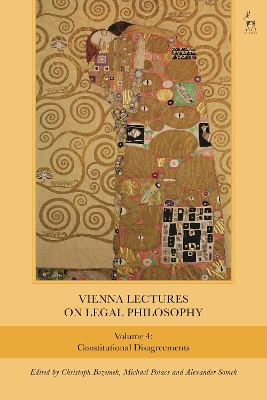
In the fourth volume of the Vienna Lectures on Legal Philosophy, scholars in contemporary jurisprudence and constitutional theory discuss who gets to decide and who gets to act when constitutional law is silent or fundamentally controversial.
It is the very purpose of Constitutions to settle disagreements: to determine who gets to decide and who gets to act when it comes to the polity and its members.
But what if, instead of settling disagreements among those subjected to it, the Constitution itself, its end, its functions, its meaning, its existence, becomes the subject of disagreements? What if the Constitution raises issues it is unable to address from the very outset? Who gets to decide then and who gets to act?
In a time in which constitutional crises seem to be too ubiquitous to still count as exceptions, questions such as these are asked with ever-increasing urgency. The answers to these questions cannot be found in arguments based on contingent legal stipulations but have to reach beyond the vague and fleeting instructions of positive law.
Muu info
Scholars in contemporary jurisprudence and constitutional theory discuss who gets to decide and who gets to act when constitutional law is silent or fundamentally controversial.
1. Democratic Law in the State of Nature: a Kantian Framework, George
Pavlakos (University of Glasgow, UK)
2. Why Constitutions? The Case for Robust Constitutionalism, Alon Harel (The
Hebrew University of Jerusalem, Israel)
3. In Defence of Constitutionalism. Navigating between a Minimal and a Total
Concept of the Constitution, Anna-Bettina Kaiser (Humboldt University,
Germany)
4. Constitutions, Basic Structures, and Amendments: The Metaphor of the
Constitution as a House, Yaniv Roznai (Interdisciplinary Centre Herzliya,
Israel)
5. Imaginary Constitutions, Martin Loughlin (The London School of Economics
and Political Science, UK)
6. Unveiling the Constitution: Why and How Material Constitution Doctrines
Matter in Constitutional Theory?, Graziella Romeo (Bocconi University,
Italy)
7. Deep Disagreements and the Constitution of a Shared World, Sophie
Loidolt (Technical University of Darmstadt, Germany)
8. Dworkin on Disagreement, Cormac Mac Amlaigh (University of Edinburgh, UK)
9. Judicial Dialogue and Constitutional Disagreements: Bridging the Gap, Koen
Lenaerts (KU Leuven, Belgium)
10. Between Expertocracy and Populism in the Justification of Public
Authority - Lessons Learned from the Pandemic, Stephan Kirste (University of
Salzburg, Austria)
11. Constitutional Law in the Pandemic Contested Self-Images and
Popular/Populist Appropriations, Marie-Luisa Frick (University of Innsbruck,
Austria)
12. The Linchpin of Constitutional Discipline, Alexander Somek (University of
Vienna, Austria)
Christoph Bezemek is Professor of Law at the University of Graz, Austria. Michael Potacs is Professor of Law at the University of Vienna, Austria. Alexander Somek is Professor of Law at the University of Vienna, Austria, and Global Affiliated Professor of Law at the University of Iowa, USA.