Muutke küpsiste eelistusi

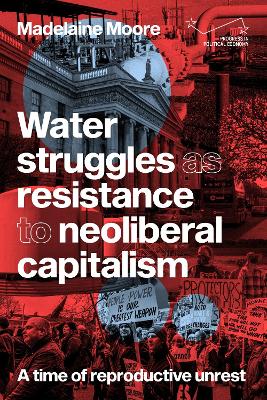
Water Struggles as Resistance to Neoliberal Capitalism: A Time of Reproductive Unrest [Kõva köide]

  • Formaat: Hardback, 240 pages, kõrgus x laius x paksus: 234x156x14 mm, kaal: 508 g
  • Sari: Progress in Political Economy
  • Ilmumisaeg: 21-Mar-2023
  • Kirjastus: Manchester University Press
  • ISBN-10: 1526165988
  • ISBN-13: 9781526165985
  • Kõva köide
  • Hind: 94,20 €*
  • * hind on lõplik, st. muud allahindlused enam ei rakendu
  • Tavahind: 117,75 €
  • Säästad 20%
  • Raamatu kohalejõudmiseks kirjastusest kulub orienteeruvalt 3-4 nädalat
  • Kogus:
  • Lisa ostukorvi
  • Tasuta tarne
  • Tellimisaeg 2-4 nädalat
  • Lisa soovinimekirja
  • Formaat: Hardback, 240 pages, kõrgus x laius x paksus: 234x156x14 mm, kaal: 508 g
  • Sari: Progress in Political Economy
  • Ilmumisaeg: 21-Mar-2023
  • Kirjastus: Manchester University Press
  • ISBN-10: 1526165988
  • ISBN-13: 9781526165985
This book provides an important intervention into social reproduction theory and the politics of water. Presenting an incorporated comparison, it analyses the conjuncture following the 2007 financial crisis through the lens of water expropriation and resistance. This brings into view the way that transnational capital has made use of and been facilitated by the strategic selectivities of both the Irish and the Australian state, as well as the particular class formations that emerged in resistance to such water grabs. What is revealed is a crisis-ridden system that is marked by increasing reproductive unrest – class understood through the lens of social reproduction theory. As an important analysis of two significant water struggles, the book makes a compelling argument for integrating the study of social movements within critical political economy.

Water struggles as resistance to neoliberal capitalism is an important intervention into social reproduction theory and eco-socialist debates. It provides a timely analysis of the role of expropriation in the current global water crisis and makes a persuasive argument for understanding class as an emergent process constituted through struggle.

Arvustused

Shortlisted for the 2024 BISA IPEG book prize

'The planets water is in peril, seen as a resource for the global economy at the service of transnational capital. In her powerful new book, Madelaine Moore shows us that water does not exist outside the politics and culture that shapes our core values. To protect water and the human right to water requires a profound commitment to social change and true democracy from the ground up.' Maude Barlow, water activist and co-founder Blue Planet Project

Madelaine Moores concept of reproductive unrest provides a sophisticated lens on emerging resistances to the world-wide commercialisation of water services. Her comparison of distinctive instances of water grabbing in Australia and Ireland foregrounds a global patterning of public services captured by transnational capital. Corresponding civic mobilisations animate her sensitive exposition of maturing socio-ecological movements in defence of social reproduction needs. Moores analysis offers an exemplary inquiry into the changing complexion, meaning and impact of contemporary anti-capitalist resistances. Philip McMichael, Professor Emeritus of Global Development, Cornell University

'A remarkable aspect of the book lies in its engagement with long-term historical developments to characterise the various types of neoliberal regimes co-existing today and why these issues matters to understand water struggles.' Basile Boulay, EADI Debating Development Research Blog -- .

Acknowledgements viii
List of abbreviations
xi
Introduction: Why Water, Why Now? 1(12)
1 Theorising reproductive unrest
13(38)
2 Water grabbing as a form of capital accumulation
51(34)
3 The strategic selectivities of the state
85(28)
4 The contestation of water grabs in Australia
113(30)
5 The contestation of water grabs in the Republic of Ireland
143(30)
Conclusion: A Conjuncture of Reproductive Unrest 173(14)
References 187(24)
List of interviews 211(2)
Index 213
Madelaine Moore is a Postdoctoral Researcher in Sociology at the University of Bielefeld -- .