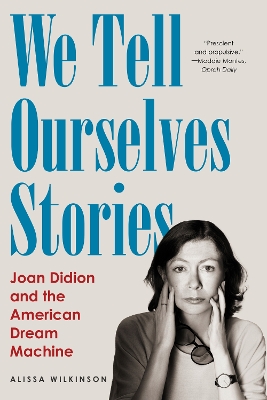
"[ A] thoughtful, perceptive new study of Didion and her relationship to movies.... For all her legendary cool, the controlling emotion of [ Didion's] work is almost always dismay. How could the world be like this? The dream from which she fell into that disillusionment, Wilkinson convincingly suggests, was the silver screen. We Tell Ourselves Stories has lots of excellent details.... But its strongest sections are the ones that question rather than venerate [ Didion]. Wilkinson is superb at dissecting the overlap of film and politics in Didions worldview.... We tell ourselves stories in order to live. This searching, conscientious book leaves us with the question of what happens when everyone stops believing them at once." -- Charles Finch - New York Times Book Review "We Tell Ourselves Stories details how one of our most important writers lived in the shadow of the movies, how they possessed her imagination and, far more crucially, how that imagination worked both within and upon Hollywood." -- Matthew Specktor - Washington Post "Wilkinson floats an idea: to truly understand Didion, one must look through the lens of American mythmaking in Hollywood. Wilkinsons book got me curious enough about Didion and Dunnes collaborations to visit or revisit all seven of their produced scripts. As I boned up on the couples wildly eclectic scripted outputprojects all over the map in tone, scale, quality, prestige, and ambitionI found my answer: about their status as screenwriters, Didion and Dunne cared a lot." -- Nell Beram - Vogue "Insightful and generous.... A way of reading the overlapping and contradictory desires that inform Didions writing in her differing modes and across her various career stages. Our lives now depend on creating a mature, inclusive, and visionary national culture and politics that refuses Hollywood game show dreams. We Tell Ourselves Stories will be useful in preparing for that cultural remaking." -- Walton Muyumba - Boston Globe "In We Tell Ourselves Stories, Wilkinson, the movie critic, zooms in on the almost 40 years that Didion and Dunne worked for Hollywood. Wilkinsons title is a fragment of Didions most famous and most misunderstood line: We tell ourselves stories in order to live has by now passed into Didion cliché, but it was not, Wilkinson points out, intended as a positive; it is not the inspirational quotation that many believe it to be. Rather, storytelling, the imposition of narrative, regardless of truth, is our bulwark against chaos, against meaninglessness. And the stories themselves, Wilkinson argues, come from one place in particular: the movies. Didion knows intimately that it is Hollywood, Americas dream factory, that has taught us who we are, Wilkinson writes. It was Hollywood that was devoted to telling us we were fine. We were going to be fine."" -- Casey Schwartz - New York Times "By focusing on her oft-overlooked role in the movie business, New York Times film critic Wilkinson invites us to see the literary icons writingand our own screen-obsessed culturewith fresh eyes.... Even if youre not a fan of Didionor if you think you already know everything about the obsessively chronicled staryou will uncover the literary evolution of her work in this prescient and propulsive read." -- Mandie Montes - Oprah Daily "Please read We Tell Ourselves Stories." -- Book Reporter "The book centers on Didion, of course, but it also serves as a survey of 20th century attitudes toward film and politicsand deftly details how American storytelling translates from TV screen to political narrative." -- Chelsea Boes - World "Wilkinsons account is an imaginative biography of a great writer from the past century, less concerned with Didions personal details than the cultural forces that engaged her." -- Shepherd Express "Amid a spate of new books about Joan Didion published since her death in 2021, this entry by Wilkinson (one of my favorite critics working today) stands out for its approach, which centers Hollywoodand its meaning-making apparatusas an essential key to understanding Didions life and work." -- The Millions, "Most Anticipated Books of Winter 2025" "New York Times film critic Wilkinson (Salty) serves up a perceptive study of Hollywoods influence on Joan Didions outlook and literary sensibilities . . . Wilkinsons penetrating analysis uncovers the profundity of Didions famous assertion that we tell ourselves stories in order to live, cleverly using the writers biography to explore how narratives shape reality. Of the numerous books on Didion released after her death in 2021, this ranks near the top." -- Publishers Weekly "A writer at the movies. New York Times film critic Wilkinson focuses on the connection to movies, celebrity, and Hollywood that shaped Didions 'cool-eyed views of societal collapse, cultural foolishness, personal anxiety, and political strife. A thoughtful look at a literary star.'" -- Kirkus Reviews "Rather than offer a biography of Joan Didion and her enduring legacy in our internet age, New York Times film critic Wilkinson gives us a cultural case study of the country Didion wrote about. Deftly researched, this book is a thought-provoking look at postwar American culture and how Didions work serves as both solace and warning about the power of the stories we tell." -- Courtney Eathorne - Booklist "Peering through a scrim of celluloid, Wilkinson incisively dissects the cinematic motifs and machinations that informed Didions writingand how her writing, ultimately, demonstrated Hollywoods addictive grasp on the American imagination. More than a portrait of a writer, We Tell Ourselves Stories shines a new light on a legacy whose impact will be felt for generations." -- Englewood Review of Books "A gripping cultural history of Joan Didions relationship with Hollywood, politics, and America itself. . . . Her spare prose captured the disillusion of a generation. Alissa Wilkinson expertly conjures that time and place in this smart, moving, and lyrical account of Didions California dreams." -- Heather Clark, author of Red Comet: The Short Life and Blazing Art of Sylvia Plath "No one was more attuned than Joan Didion to the rhythms of American movie-making. . . . Alissa Wilkinson has written a penetrating account of Didions acuity. We Tell Ourselves Stories is an invaluable education and a timely warning." -- Tracy Daugherty, author of The Last Love Song: A Biography of Joan Didion "The perfect guide to one of Americas most celebrated literary pioneers, exploring the ways in which Didion taught herself to resist Americas deepest mythologieseven those she had originally embraced." -- Emily Nussbaum, author of Cue the Sun! and I Like to Watch "More than an essential contribution to the Didion canon, We Tell Ourselves Stories delves into the evolution of American consciousness with dizzying intelligence and insight." -- Julia May Jonas, author of Vladimir "A vital new take on Joan Didions work, exploring the ways Didion traced the gradual, and increasingly dangerous, merging of Hollywood and its gorgeous fictions with politics, with the uppermost ranks of power, and, perhaps most sweepingly, with the way we understand the world and ourselves." -- Megan Abbott, author of The Turnout "Absorbing and beautifully tolda pleasure to read. . . . This is a compelling account of a remarkable womans intellectual and literary evolution." -- Mary V. Dearborn, author of Carson McCullers: A Life