Muutke küpsiste eelistusi

What Europeans Think About Immigration and Why It Matters [Kõva köide]

(Professor, Migration Policy Centre, European University Institute), (Professor of Migration Studies and Director of the Migration Policy Centre, European University Institute)
  • Formaat: Hardback, 224 pages, kõrgus x laius: 234x156 mm
  • Ilmumisaeg: 25-Jun-2026
  • Kirjastus: Oxford University Press
  • ISBN-10: 019288994X
  • ISBN-13: 9780192889942
  • Kõva köide
  • Hind: 34,80 €*
  • * hind on lõplik, st. muud allahindlused enam ei rakendu
  • Tavahind: 43,50 €
  • Säästad 20%
  • See raamat ei ole veel ilmunud. Raamatu kohalejõudmiseks kulub orienteeruvalt 3-4 nädalat peale raamatu väljaandmist.
  • Kogus:
  • Lisa ostukorvi
  • Tasuta tarne
  • Tellimisaeg 2-4 nädalat
  • Lisa soovinimekirja
  • Formaat: Hardback, 224 pages, kõrgus x laius: 234x156 mm
  • Ilmumisaeg: 25-Jun-2026
  • Kirjastus: Oxford University Press
  • ISBN-10: 019288994X
  • ISBN-13: 9780192889942
Immigration is one of the most polarising and political consequential issues in 21st-century Europe. What Europeans Think About Immigration and Why It Matters offers a powerful and comprehensive analysis of the matter, mapping not only what Europeans think about immigration, but why they think it, how those attitudes are formed, and what they mean for the political future of Europe.

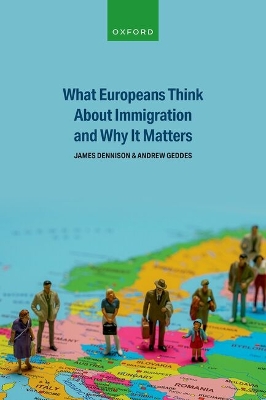
Drawing on vast quantities of high-quality survey data spanning decades, countries, and crises, and combining insights from political science, psychology, sociology, and public policy, James Dennison and Andrew Geddes provide a new, interdisciplinary framework for understanding immigration attitudes. They explain how early-life socialization, emotional predispositions, values, media, economic conditions, and national contexts interact to shape how Europeans perceive immigration. With attitudes shown to be more stable, multidimensional, and resistant to change than many politicians, journalists, and policymakers assume, the book debunks common myths and reveals the complex interplay between beliefs, feelings, and facts that drive public opinion.

Beyond identifying what people think, the book offers a theoretical and empirical framework for understanding salience—why immigration becomes politically important at some times but not others. It explains how and why immigration rises up the public agenda, why it resonates with some voters more than others, and what this means for party competition, policymaking, and the communication strategies used by politicians, journalists, and activists. Dennison and Geddes explore how salience, not just sentiment, has been key to the rise of radical-right parties and to far-reaching shifts in national and EU-level migration policies.

This book is essential reading for scholars, students, policymakers, and anyone seeking to understand the deeper cognitive, emotional, and structural forces that shape how we see and govern migration.

This book offers a powerful and comprehensive analysis of immigration, mapping not only what Europeans think about the issue, but why they think it, how those attitudes are formed, and what they mean for the political future of Europe.
James Dennison is part-time Professor at the Migration Policy Centre of the European University Institute in Florence, Italy, and the Pierre Keller Professor at the Harvard Kennedy School. His research interests include social and political attitudes, behaviour, and communication, migration, and quantitative methods and has been published in dozens of leading scientific journals. He holds a PhD from the European University Institute and has secured numerous grants and international collaborations. He regularly advises international organizations such as the United Nations and European Commission, political parties, NGOs, and private sector organizations on how to effect change with evidence-based solutions. His work has been featured repeatedly in international media.

Andrew Geddes is a Professor of Migration Studies and Director of the Migration Policy Centre at the European University Institute in Florence, Italy. He has published extensively on the politics of migration in Europe and globally. His work has been supported by an Advanced Grant from the European Research Council between 2014 and 2019 and between 2024 and 2027 he is leading a large-scale EU-funded project seeking to improve links between migration research and policy.