Muutke küpsiste eelistusi

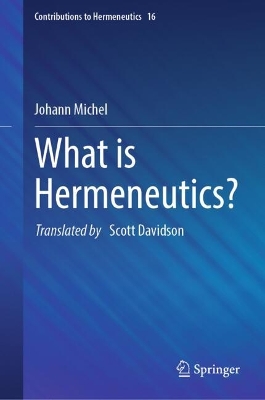
What is Hermeneutics? [Kõva köide]

  • Formaat: Hardback, 178 pages, kõrgus x laius: 235x155 mm, 1 Illustrations, black and white
  • Sari: Contributions to Hermeneutics
  • Ilmumisaeg: 24-Apr-2026
  • Kirjastus: Springer Nature Switzerland AG
  • ISBN-10: 3032161894
  • ISBN-13: 9783032161895
Teised raamatud teemal:
  • Kõva köide
  • Hind: 108,52 €*
  • * hind on lõplik, st. muud allahindlused enam ei rakendu
  • Tavahind: 144,69 €
  • Säästad 25%
  • Raamatu kohalejõudmiseks kirjastusest kulub orienteeruvalt 3-4 nädalat
  • Kogus:
  • Lisa ostukorvi
  • Tasuta tarne
  • Tellimisaeg 2-4 nädalat
  • Lisa soovinimekirja
  • Formaat: Hardback, 178 pages, kõrgus x laius: 235x155 mm, 1 Illustrations, black and white
  • Sari: Contributions to Hermeneutics
  • Ilmumisaeg: 24-Apr-2026
  • Kirjastus: Springer Nature Switzerland AG
  • ISBN-10: 3032161894
  • ISBN-13: 9783032161895
Teised raamatud teemal:
This book reveals how hermeneutics has experienced unprecedented attention under the leadership of Heidegger, Gadamer and Ricoeur, after long being confined to a restricted field of disciplines focused on understanding discourse. The author confronts the following questions: What is understanding? How to interpret a work of art? Can we decipher nature? How to orient yourself in space?


This monograph reveals how hermeneutics leaves the refuge of erudition to become a new field of philosophical exploration centered on the life of the spirit, on modes of existence and on traditions. It proposes an in-depth renewal of hermeneutics through a close dialogue with semiotics, pragmatism and the social sciences with the aid of three guiding ideas. The first, anthropological, makes interpretation a fundamental activity of humans in their ordinary activities, before making it a set of techniques in the service of scientific knowledge. The second, pragmatist, reserves interpretation for a reflective understanding confronted with problematic meanings. The third, epistemological, extends the field of investigation of hermeneutics beyond the text (nature, others, space, the work of art, the social world, etc.). Alongside researchers, this book serves as an advanced introduction to the field and appeals to upper undergraduates and graduate students.
Introduction
1. Grasping a sign.-
2. Deciphering nature.-
3.
Understanding something.-
4. Having an experience.-
5. Orienting in space.-
6.Interpreting a work of art.-
7. Responding to strangeness.-
8. Reading the
social.-
9. Criticizing.
Johann Michel is Professor of Philosophy and Political Science at the University of Poitiers, a researcher attached to EHESS (Paris), and member of the Institut Universitaire de France. He is a specialist in hermeneutics and social theory, and the author of around fifteen works , translated into several foreign languages (English, German, Portuguese, Spanish, Arabic), notably Homo Interpretans, Towards a transformation of hermeneutics (2019) and The reparable and the irreparable (2022). He has been Professor or keynote speaker in more than 40 foreign universities. He is Laureate of the 2023 research prize from Academy of Moral and Political Sciences (France).