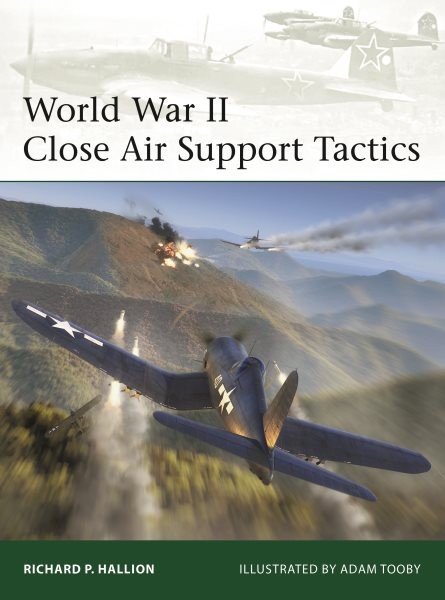
In this study, an acknowledged expert charts the development of close air support and battlefield air interdiction in theory and practice during World War II.
In World War I the use of aircraft to support ground operations was in its infancy, and it was only after the start of the Spanish Civil War in 1936 and the Second Sino-Japanese War in 1937 that close air support (CAS) and battlefield air interdiction (BAI) began to evolve towards a recognizably modern form. Using innovative all-new artwork from renowned illustrator Adam Tooby, Richard Hallion shows how the Blitzkrieg campaigns of 1939–41 saw the highly effective deployment of German dive-bombers, while the British, French and Soviet air forces strove to counter the Luftwaffe's CAS measures with variable degrees of success.
The British and Americans developed their own CAS doctrine in the Mediterranean during 1941–43, further refining it during the campaigns in Western Europe in 1944–45. Meanwhile during the fighting in Asia and the Pacific, the Japanese and their Allied opponents employed CAS techniques. Full-colour tactical diagrams, carefully chosen archive photographs and insightful analysis reveal how by 1945, Allied CAS doctrine had reached new levels of sophistication, boosted by the growing availability of dedicated aircraft, ordnance and communications technology.
In this study, an acknowledged expert charts the development of close air support and battlefield air interdiction in theory and practice during World War II.Muu info
In this illustrated study, an acknowledged expert charts the development of close air support and battlefield air interdiction in theory and practice during World War II.
[ subject to confirmation]
Introduction
Origins 191639
Blitzkrieg 193940
The Mediterranean 194143
The Eastern Front 194145
Asia and the Pacific 194145
North West Europe 194445
Bibliography
Index
Richard P. Hallion, formerly Historian of the US Air Force, is an internationally recognized authority on close air support and battlefield air power in the 191145 period. He is the author of Rolling Thunder 196568, Desert Storm 1991, and The Wright Flyers 18991916.
Adam Tooby is an internationally renowned digital artist and illustrator.