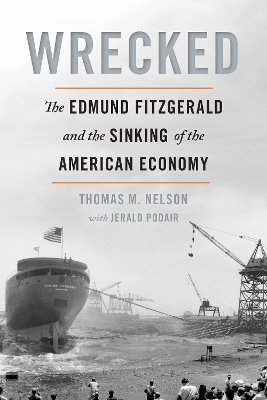
Wrecked links the story of America’s most infamous shipwreck to the story of an even larger disaster—the wreck of the American industrial economy. When the Edmund Fitzgerald went down in a Lake Superior storm on November 10, 1975, more was lost than the ship and the twenty-nine lives on board. The disaster was a human tragedy as well as an indictment of the American industrial policies that eventually cost the nation thousands of jobs and marooned hundreds of communities. Written with a passionate yet factually grounded intensity, Wrecked shows that the reasons for the decline of industrial manufacturing in the upper Midwest are linked to why the Edmund Fitzgerald sank, and to the legal turmoil that followed for the victims’ families. The book conveys the sense of loss that still is felt by those affected, along with the outrage over the disappearance of manufacturing jobs and the inadequate maintenance and legal maneuvering over liability for the sinking of the ship. What follows is a fascinating critique of what went wrong and why.
Wrecked links the story of America’s most infamous shipwreck to the story of an even larger disaster—the wreck of the American industrial economy. When the Edmund Fitzgerald went down in a Lake Superior storm on November 10, 1975, more was lost than the ship and the twenty-nine lives on board. The disaster was a human tragedy as well as an indictment of the American industrial policies that eventually cost the nation thousands of jobs and marooned hundreds of communities.
Arvustused
This is the most thorough and complete work covering the sinking of the Edmund Fitzgerald. If you want to know everything about this tragedy, then you need to read this book. Toby Marcovich, attorney for the families of crew members lost with the Edmund Fitzgerald Over the last forty years, the United States has undergone wrenching transformationsdeindustrialization, declining unionization, and rising inequalitywhich have coincided with increasingly dysfunctional politics. Thomas Nelson masterfully marries this narrative to that of the infamous sinking of the USS Edmund Fitzgerald on Lake Superior in 1975. This provocative new book unites a compelling narrative of the accident and its social aftermath with a powerful call for the rebuilding the U.S. industrial base. Nolan McCarty, Susan Dod Professor of Politics and Public Affairs, Princeton University Thomas Nelson has excavated the wreckage of one of Americas greatest tragedies to help us understand where our politics have gone wrong. As this book powerfully shows us, workers across the United States have been let down in the last few decades, just as the workers on the Edmund Fitzgerald and their families were let down in 1975. Nelson urges us to learn from this tragedy and offers a compelling path to restore a true workers democracy in the United States. This book couldnt be more timely. Jon Shelton, Professor and Chair of Democracy and Justice Studies, University of WisconsinGreen Bay Lovers of Gordon Lightfoots ballad The Wreck of the Edmund Fitzgerald will read Wrecked to find out what actually happened to both the ship and its individual crew members. Thomas Nelson and Jerald Podair succeed in intertwining this tale with a bigger and equally heart-wrenching story: the disappearance of American manufacturing, the rusting and decline of unions, the disintegration of infrastructure and safety standards, and the abandonment of American workers. Anne-Marie Slaughter, CEO, New America
Thomas M. Nelson is the Outagamie County executive (AppletonFox Valley, Wisconsin) and a former Wisconsin Assembly majority leader (20082010). His first book, One Day Stronger: How One Union Local Saved a Mill and Changed an Industryand What It Means for American Manufacturing, is based on his work as an elected official to save a paper mill that had been shut down by a big bank and sold to a scrap dealer. The improbable tale earned him a starred Kirkus Review. Nelson has served in elective office for twenty years and is a seasoned campaigner having run for U.S. House of Representatives (2016) and U.S. Senate (2022). His unique political experience yields important insights into his writing. Along with thoroughly researched subjects and effective use of vibrant, engrossing prose, his books are accessible to a wide audience.
Jerald Podair is professor of history and the Robert S. French Professor of American Studies Emeritus at Lawrence University. He is the author of The Strike That Changed New York: Blacks, Whites, and the Ocean HillBrownsville Crisis, a finalist for the Organization of American Historians Liberty Legacy Foundation Award for best book on the struggle for civil rights in the United States and honorable mention for the Urban History Association Award for best book on North American urban history. His City of Dreams: Dodger Stadium and the Birth of Modern Los Angeles won the Harold and Dorothy Seymour Medal of the Society for American Baseball Research for best book on the history of baseball and was a finalist for the PEN/ESPN Award for Literary Sports Writing. His other books include The Routledge History of the Twentieth-Century United States (coeditor); Republican Populist: Spiro Agnew and the Origins of Donald Trumps America; American Conversations: From the Centennial through the Millennium; The Struggle for Equality: Essays on Sectional Conflict, the Civil War, and the Long Reconstruction (coeditor); and Bayard Rustin: American Dreamer. A two-time winner of Lawrence Universitys Award for Excellence in Scholarship, he is the recipient of the Society of American Historians Allan Nevins Prize for literary distinction in the writing of history and an elected fellow of the New York Academy of History. He was also a member of the Wisconsin Abraham Lincoln Bicentennial Commission. His work has been published in the American Historical Review, the Journal of American History, Time, the Washington Post, the Guardian, the Los Angeles Times, the Los Angeles Review of Books, Commentary, American Heritage, and History Today.