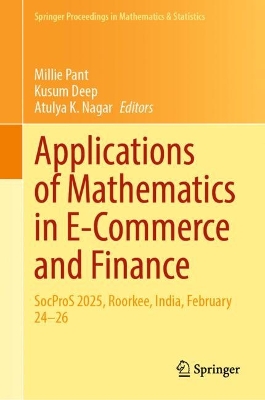
This book offers a comprehensive collection of 46 research contributions presented at the 13th International Conference on Soft Computing for Problem Solving (SocProS 2025): Artificial Intelligence for Viksit Bharat (that is, developed India), held at the Indian Institute of Technology Roorkee, Uttrakhand, India, from 2426 February 2025. It discusses how machine learning, deep learning, optimization and intelligent systems are revolutionizing engineering and commercial practices through applications of mathematics. Covering diverse topics such as facial recognition security, cryptocurrency and blockchain technologies, automated trading, sustainable inventory management, personalized recommendation systems and IoT-driven smart solutions, the book highlights both theoretical advancements and practical implementations of mathematics across a wide range of disciplines.
This book also addresses emerging areas like green energy management, speech recognition, multilingual language technologies and climate analytics. With a strong emphasis on interdisciplinary research, the chapters integrate computational intelligence, engineering innovations and business applications, providing readers with a holistic view of current trends and future opportunities. This book serves as a valuable reference for researchers, practitioners, industry professionals and students aiming to leverage machine learning and optimization techniques for engineering and e-commerce challenges.
Chapter
1. Fooling A Deep Learning-based Facial Expression
Recognition System using its Class Activation Map and Differential
Evolution.
Chapter
2. Cryptocurrency and Blockchain The Future Of
Finance?.
Chapter
3. AI-Powered Custom Emoji Generator: Enhancing Digital
Expression and Engagement.
Chapter
4. A Comparative Analysis of
Classification with Explainability of Customer Churn Prediction.
Chapter
5.
Precision Strontium Detection in Water: A Machine Learning Augmented Flame
Photometric Approach.
Chapter
6. Comparative Analysis of Random Forest
and SVM for EMG-Based Gesture Recognition.
Chapter
7. Comparative study
of CNN and LSTM deep learning models for EMG signals for gesture
recognition.
Chapter
8. Data-Driven Insights from High-Dimensional
Time-Series Signals: A Comprehensive Analysis Approach.
Chapter
9. An
Intuitionistic Fuzzy Differential Equation Approach to Economic Production
Inventory Model.
Chapter
10. Observation of Reliability, BER, FER, BLER
and throughput during the coexistence of 4G LTE and 5G NR.
Chapter
11.
Byzantine Linearizability: Reliable Broadcast, Snapshots and Asset Transfer
for Bounded Memory.
Chapter
12. A Green Supply Chain Approach under
Market Displacement Factor for Novel and Refurbished Inventory.
Chapter
13.
Power Fluctuation Detection Technique in Solar Power Plant Using Machine
Learning.
Chapter
14. Benefits of Hybrid Demand in a Sustainable
Inventory Model with Advance Payment Discount Facility under Preservation and
Green Technology.
Chapter
15. Reducing Operational Costs with
Cost-Sensitive XG-Boost-Based Failure Prediction.
Chapter
16. Enhanced
Hybrid DEA Approach for Predicting Hotel Efficiency: Probabilistic and Neural
Network Approaches.
Chapter
17. End-to-end trained Punjabi ASR system
with Tonal Features.
Chapter
18. Granular Ball Random Forest for Robust
Classification.
Chapter
19. Tolerance based feature selection of an
incomplete interval-valued data.
Chapter
20. Design and implementation of
Algorithmic Trading system using Alpaca and Lumibot.
Chapter
21.
ML-Maestro: No Code Machine Learning with Interactive Data Visualization.-
Chapter
22. A Multimodal Approach to Recommendation Systems: Integrating
User Preferences and Item Analysis.
Chapter
23. A Supply Chain Inventory
Model with Fuzzy Environment in Circular Economy.
Chapter
24. Object
Identification for Visually Impaired using IoT with Image Processing and
Voice Conversion.
Chapter
25. Pronominal and Nominal Coreference
Resolution in Assamese: A Linguistic Rule-Based Framework.
Chapter
26.
Enhanced Sentiment Analysis Using the RoBERTa-GRU Hybrid Model for Noisy
Social Media Data.
Chapter
27. Design and Development of a Robust
Assamese Language Dataset for Author Attribution.
Chapter
28. Unraveling
Plasticity Loss in Deep Neural Networks Under Non-Stationary Objectives.-
Chapter
29. Mapping SDG Goals with ESG Strategies using Topic Modeling: An
Analysis of FMCG Sector.
Chapter
30. A Comparative Study of Vowel Systems
in Five NorthEast Indian Languages: Phonetic Charts and Acoustic Features in
Bodo, Karbi, Mising, Nepali, and Tiwa.
Chapter
31. Causal Similarity and
Feature Engineering for Stock Movement Prediction.
Chapter
32. Enhancing
Interpretability and Diagnostic Accuracy in CNN-Based Mammography Analysis.-
Chapter
33. Coral Classification and Detection: Advancing Underwater
Imaging for Biodiversity Monitoring.
Chapter
34. FurMatch: A Smart System
for Personalized Dog Breed Recommendations.
Chapter
35. Evaluating
cultural awareness of prominent Vision Language Models for Assamese Handloom
Saree.
Chapter
36. Comparative Analysis of Statistical, Machine Learning,
and Deep Learning Models for NIFTY 50 Financial Forecasting.
Chapter
37.
Innovative EV charging approach Implicating IoT A Smart and User Friendly
Concept.
Chapter
38. Portable, Low-Cost, Capacitor-Loaded On-Field I-V
Curve Tracer for Solar Photovoltaic Modules with Low Power Rating.
Chapter
39. Spatial and Temporal analysis of Tropical Indian Ocean Climate modes.-
Chapter
40. Urban sprawl: Analyzing Development and Change Detection Using
GEE in Vijayawada.
Chapter
41. Ignition Time Prediction of Live Shrubs
Using Machine Learning.
Chapter
42. ToMEto: A Fusion Cuisine Platform for
Recipe Innovation and Ingredient Substitution.
Chapter
43. Effect of
variable thickness on the thermal buckling behavior of functionally graded
circular plates.
Chapter
44. Recent Five Years Comprehensive Review for
Green Supplier Selection with Advanced Decision Techniques.
Millie Pant is Professor in the Department of Applied Mathematics and Scientific Computing at the Indian Institute of Technology Roorkee, Uttrakhand, India. She specializes in data science and artificial intelligence, with significant contributions to optimization algorithms and their applications. She has a robust publication record and has guided numerous Ph.D. and M.Tech. students, reflecting her commitment to research and education in advanced mathematical and computational methods. Kusum Deep is Full Professor (HAG) in the Department of Mathematics as well as Joint Faculty at the Mehta Family School of Data Science and Artificial Intelligence at the Indian Institute of Technology Roorkee, Uttrakhand, India. Also, she is Visiting Professor, Liverpool Hope University, UK; University of Technology Sydney, Australia; and University of Wollongong, Australia. With B.Sc. Hons and M.Sc. from the Centre for Advanced Studies, Panjab University, Chandigarh, India, she is an M.Phil. gold medalist. She earned her PhD from the University of Roorkee, now the Indian Institute of Technology (IIT) Roorkee, in 1988. She has been a national scholarship holder and a Post-Doctoral from Loughborough University, UK assisted by International Bursary funded by the Commission of European Communities, Brussels. She has won numerous awards like the Khosla Research Award, the UGC Career Award, the Starred Performer of IITR Faculty, best paper awards by the Railway Bulletin of Indian Railways, special facilitation in memory of late Prof. M. C. Puri, the AIAP Excellence Award. She is one of the four women from the IIT Roorkee to feature in the ebook, Women in STEM-2021, celebrating the contributions made by 50 Indian women in STEM published by the Confederation of Indian Industries. According to Stanford University, she falls within the top 2% of the scientists in the world for 2019 and 2020. In 2021 she bagged the prestigious POWER grant awarded by SERB-DST, the Government of India. Atulya K. Nagar is the Foundation Chair Professor in the School of Mathematics, Computer Science and Engineering as well as Pro Vice-Chancellor (Research) at Liverpool Hope University, United Kingdom. He received a prestigious Commonwealth Fellowship for pursuing his doctorate (DPhil) in applied nonlinear mathematics, which he earned from the University of York (UK) in 1996. He holds BSc (Hons), MSc and MPhil (with distinction) in mathematical physics from the MDS University of Ajmer, Rajasthan, India. He is a fellow of the Institute of Mathematics and Its applications (FIMA) and a fellow of the Higher Education Academy (FHEA). His research expertise is in the area of applied nonlinear analysis, natural computing and systems engineering.