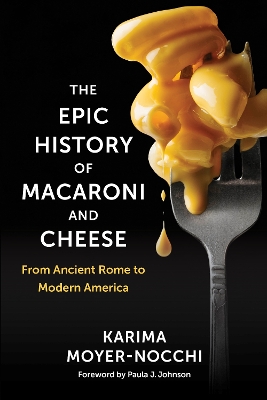
"Macaroni and cheese is experiencing an upsurge in popularity. Given the stressful times we are living through, cozying up to the queen of comfort foods is not surprising and should even be expected, as books like 350 Macaroni and Cheese Recipes: Keep Calm and Try Macaroni and Cheese Cookbook (2020) imply. The dish is not making a comeback from obscurity. On the contrary, as the epic history of macaroni and cheese shows, it has only ever been on an upward trend. But, beloved as the dish is the world over, little is known about its backstory, not only culinarily, but of what it reveals about centuries of social evolution, and the role it has played in issues having to do with race, class, and gender. From its earliest origins in ancient Rome, the history of macaroni and cheese has been enmeshed in questions of social class and status: paraded as status marker on the elite table, promoted as a solution to feeding the poor, and embraced by middle class homemakers. In passing from the hands of European male chefs cooking for the aristocracy to female cookbook authors, and appropriated as a tradition into American kitchens where it became the legacy of African American women, it embodies questions of gender, race, authority, and identity. Looking at its manufacture from the ends of the continuum, what started as a handmade delicacy laced with costly spices ended up as a ubiquitous boxed kit of elbows with powdered orange cheese in America. Macaroni and cheese has a historical story rife with myths and errors.The author reveals how, over the centuries, the dish came to be considered uniquely American. However, while there is a notable American emphasis, the book's focus rests more broadly on the culinary evolution and social history of the dish. The main source for the author's analysis up to and including the 19th century is historical cookbooks. Other primary sources include literature, travelogs, expense accounts, trade records, oral histories, and dictionaries. Into the 20th century, primary sources include oral histories, interviews, newspapers and journals, and business records. Historical recipes will provide direct insight into the evolution of the dish. About fifteen recipes are remapped for the modern kitchen and included in this book. A sweatshirt slogan that went viral over the 2022 Thanksgiving holiday read "The macaroni is more important than the turkey." Just as happened in the Renaissance, today's chefs are approaching macaroni and cheese as a professional challenge. Those who are not "perfecting" the dish are exploring its potential variants. But the rise of "mac n cheese" is not just something chefs are interested in. Many people have profound childhood memories of when, where, and how they ate it. The love of the dish is boundless."-- Provided by publisher.
Today, macaroni and cheese is the ultimate comfort food, a staple of weeknight dinners, family gatherings, and Soul Food restaurants. Humble though the dish may seem, its history is filled with surprising twists and turns. Renaissance cardinals and popes dined on elaborate pasta-and-cheese concoctions laced with costly spices. In the eighteenth century, wealthy young Englishmen made macaroni a symbol of continental sophistication. Black women cooks, whose contribution has long been overshadowed, played a crucial role in establishing the dish as an American tradition from the nation’s founding through the Civil Rights Movement.
This book is a delectable history of macaroni and cheese, tracing an extraordinary journey of cultural exchange and social change. Karima Moyer-Nocchi reveals the religious, political, and industrial forces that forged its evolution alongside stories of the unsung figures who shaped the dish as we know it today: enslaved cooks who preserved and adapted traditions, immigrant chefs who introduced new variations, and practical homemakers looking to nourish their families with an affordable meal. She emphasizes the adaptability of macaroni and cheese, which in different times has served as both an indulgence on the elite table and sustenance to those struggling to survive, crossing borders, social classes, and cultural divides. Deeply researched and rich with enticing details, this book uncovers the creativity and resilience that brought a beloved food to our tables. The Epic History of Macaroni and Cheese also shares centuries of recipes—from ancient Roman authors to celebrity chefs, reworked for modern kitchens—that provide a hands-on portal to experience the evolution of this iconic dish.
This book is a delectable history of macaroni and cheese, tracing an extraordinary journey of cultural exchange and social change.