Muutke küpsiste eelistusi

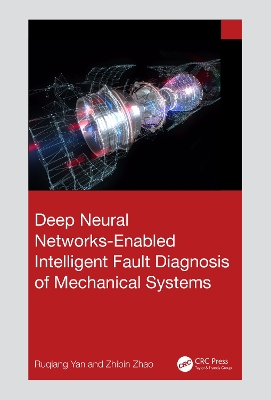
Deep Neural Networks-Enabled Intelligent Fault Diagnosis of Mechanical Systems [Pehme köide]

  • Formaat: Paperback / softback, 206 pages, kõrgus x laius: 254x178 mm, 36 Tables, black and white; 87 Line drawings, black and white; 14 Halftones, black and white; 101 Illustrations, black and white
  • Ilmumisaeg: 22-Jun-2026
  • Kirjastus: CRC Press
  • ISBN-10: 1032757248
  • ISBN-13: 9781032757247
Teised raamatud teemal:
  • Pehme köide
  • Hind: 55,90 €*
  • * hind on lõplik, st. muud allahindlused enam ei rakendu
  • Tavahind: 74,54 €
  • Säästad 25%
  • See raamat ei ole veel ilmunud. Raamatu kohalejõudmiseks kulub orienteeruvalt 3-4 nädalat peale raamatu väljaandmist.
  • Kogus:
  • Lisa ostukorvi
  • Tasuta tarne
  • Tellimisaeg 2-4 nädalat
  • Lisa soovinimekirja
  • Formaat: Paperback / softback, 206 pages, kõrgus x laius: 254x178 mm, 36 Tables, black and white; 87 Line drawings, black and white; 14 Halftones, black and white; 101 Illustrations, black and white
  • Ilmumisaeg: 22-Jun-2026
  • Kirjastus: CRC Press
  • ISBN-10: 1032757248
  • ISBN-13: 9781032757247
Teised raamatud teemal:
The book aims to highlight the potential of deep learning (DL)-enabled methods in intelligent fault diagnosis (IFD), along with their benefits and contributions.

The authors first introduce basic applications of DL-enabled IFD, including auto-encoders, deep belief networks, and convolutional neural networks. Advanced topics of DL-enabled IFD are also explored, such as data augmentation, multi-sensor fusion, unsupervised deep transfer learning, neural architecture search, self-supervised learning, and reinforcement learning. Aiming to revolutionize the nature of IFD, Deep Neural Networks-Enabled Intelligent Fault Diangosis of Mechanical Systems contributes to improved efficiency, safety, and reliability of mechanical systems in various industrial domains.

The book will appeal to academic researchers, practitioners, and students in the fields of intelligent fault diagnosis, prognostics and health management, and deep learning.
1Introduction and Background Part I: Basic applications of deep
learning enabled Intelligent Fault Diagnosis 2Auto-encoders for Intelligent
Fault Diagnosis 3Deep Belief Networks for Intelligent Fault Diagnosis
4Convolutional Neural Networks for Intelligent Fault Diagnosis Part II:
advanced topics of deep learning enabled Intelligent Fault Diagnosis 5Data
Augmentation for Intelligent Fault Diagnosis 6Multi-sensor Fusion for
Intelligent Fault Diagnosis 7: Unsupervised Deep Transfer Learning for
Intelligent Fault Diagnosis 8: Neural Architecture Search for Intelligent
Fault Diagnosis 9: Self-Supervised Learning (SSF) for Intelligent Fault
Diagnosis 10: Reinforcement Learning for Intelligent Fault Diagnosis
Ruqiang Yan is a professor at the School of Mechanical Engineering, Xi'an Jiaotong University. His research interests include data analytics, AI, and energy-efficient sensing and sensor networks for the condition monitoring and health diagnosis of large-scale, complex, dynamical systems.

Zhibin Zhao is an assistant professor at the School of Mechanical Engineering, Xi'an Jiaotong University. His research interests include sparse signal processing and machine learning, especially deep learning for machine fault detection, diagnosis, and prognosis.