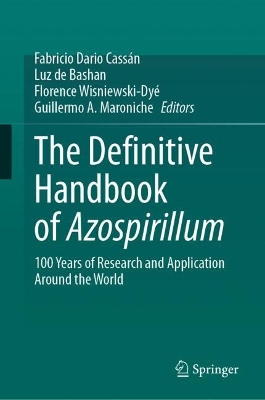
"The Definitive Handbook of Azospirillum" stands out for its comprehensive and specialized focus on Azospirillum, its detailed analysis of the evolutionary knowledge, and its practical experimental proposals. It offers a detailed examination of Azospirillum, while other texts tend to provide broader, more general, or technical perspectives on related topics.
This book not only explores the biological and ecological significance of Azospirillum but also covers the various roles it plays in different environments, especially in agriculture where it has potential applications as a biofertilizer. By providing both historical context and cutting-edge research, this book bridges the gap between past discoveries and future possibilities, making it a valuable tool for researchers and professionals.
Isolation, Identification and Characterization.- Localization and
Quantification of Azospirillum.- Genomic studies.- Chemotaxis and other Forms
of Taxis Behaviors.- Cell Aggregation, Biofilms, Attachment and Plant
Interaction.- Cell Cell Communication.- Stress Physiology.- Nitrogen
Metabolism.- Phytohormones and other Plant Growth Regulators.- Elicitors and
other molecular factors flagelline, LPS EPS other factors.- Biocontrol
activity.- Interaction of Azospirillum spp with plants Plant Growth
promotion.- Interaction of Azospirillum spp with plants Alleviation of
stress.- Interaction of Azospirillum spp with Microalgae.- Interaction of
Azospirillum spp with other bacteria and fungi.- Field Evaluation of
Extensive Crops.- Field Evaluation of Intensive Crops.- Field Evaluation in
synthetic consortia.- Inoculant Preparation and Formulations.- Quality
Control.- Inoculant preparation and formulations for Azospirillum spp.-
Innovative and emerging approaches in quality control of Azospirillum
inoculants.- Beyond agriculture Use of Azospirillum for environmental
purposes.
Fabricio Cassįn, PhD, is a microbiologist and Principal Researcher at INIAB-CONICET and Associate Professor at UNRC. With nearly 30 years of expertise on Azospirillum and other plant growth-promoting rhizobacteria, he has authored over 100 scientific contributions and led several international collaborations. His research bridges both fundamental and applied studies, advancing the use of Azospirillum in sustainable agriculture.
Luz de-Bashan Ph.D, is the Director of the Bashan Institute of Science in Alabama, and an Affiliate Professor in the Department of Entomology and Plant Pathology at Auburn University. Her research focuses on the interactions between Azospirillum and microalgae for biotechnological applications, the restoration of degraded soils with plant growth-promoting bacteria and native plants, and the development of bacterial inoculants.
Florence Wisniewski-Dyé is professor of microbial ecology at University of Lyon 1, France. With 25 years of expertise on plant growth-promoting bacteria, she was one of the pioneers in conducting comparative and functional genomic studies on Azospirillum; she contributed to reveal the high genomic plasticity of this genus, a trait that was critical for adaptation and interaction with host plants.
Guillermo Maroniche holds a Ph.D. in Biological Sciences and is currently an Independent Researcher of CONICET at FCA-UNMdP, Balcarce, Argentina. His research focuses on the mechanisms regulating the interspecific interaction between members of the plant microbiome, such as Azospirillum and Pseudomonas, and their host, aiming in the long term at improving the efficacy of inoculants based on synthetic microbial communities.